 Jonathan Blake
If you searched for plumbing lead generation, you are probably in one of two spots. Either the phone is quiet and you need work, or you are paying for leads and not sure they are worth it. Both are fixable, but the fix is different.
I sold face to face since 2015, ran a tree service for six years, and now co-own The Lead Venture (TLV), an agency that runs lead systems for home service businesses. I have never been a plumber, but the lesson carries over: when the customer has a problem right now, speed beats almost everything.
Short answer: the best plumbing leads come from a mix. Build the cheap sources first (your Google profile, reviews, referrals, past customers), add one paid source like Google Local Services Ads or Google Ads, and fix what happens after a lead arrives. That last part is where most plumbers quietly lose the money they already spent.
How to get plumbing leads: the honest map
Every guide on how to get plumbing leads lists the same places. What they skip is the trade-off for each. Here is the whole map first. I have kept cost qualitative on purpose. Ad prices change by city and season, and I would rather you check your own market than trust a number I made up.
| Lead source | Cost type | Speed to results | Lead quality | What it takes |
|---|---|---|---|---|
| Google Business Profile | Free, your time | Weeks to months | High, they are searching now | Complete profile, steady reviews, real photos |
| Local SEO website | Upfront build, then low ongoing | Months | High | Service pages by city, fast mobile site, tap-to-call |
| Google Local Services Ads | Pay per lead | Days to weeks | High intent, but you pay even for tire kickers | Verification, background checks, fast answers |
| Google Ads (search) | Pay per click | Days | High intent, depends on setup | Tracking, tight keywords, a landing page that converts |
| Facebook and Meta ads | Pay per lead or click | Days | Lower, people were not searching | Good creative, fast follow-up, patience |
| Shared lead vendors (Angi, HomeAdvisor, Thumbtack) | Pay per lead, often shared | Immediate | Mixed, many plumbers per lead | Instant response, price discipline |
| Exclusive leads | Pay per lead, higher | Fast | Usually better than shared | Vendor you trust, tracking |
| Referrals and realtors | Cheap, a small thank-you | Slow but steady | Highest, they trust you already | Ask every time, make it easy |
| Maintenance memberships | Your time, small discount | Slow, then compounding | Warm, they are existing customers | A simple plan and a reminder system |
| Past-customer reactivation | Almost free | Days | Warm | A list and a follow-up system |
Now the part that tells you which row is for you.
The free and cheap sources (start here)
Google Business Profile
When a homeowner searches “plumber near me,” the map results usually show up before the website results. Your Business Profile is what appears there. Google says its local results are based mainly on relevance, distance and prominence, and a complete, accurate profile helps with all three.
What to do: pick the right primary category, list every service you actually do (drain cleaning, water heaters, repipes, leak repair), set your service area honestly, add real job photos each month, and answer every question and review. A profile with a hundred real reviews and fresh photos beats a profile that has not been touched in two years.
The catch: it is slow, and it is a habit, not a project.
A local SEO website
Your website is where a profile click turns into a call. For plumbing it needs a page for each main service, a page for each city you really serve, a prominent tap-to-call number and a short booking form. Stressed customers want to know what happens next.
The mistake I see most is a pretty site that buries the phone number.
Referrals and realtors
Referrals close at the highest rate because the homeowner already trusts you. They also happen less than you think, because most plumbers never ask. The ask is simple: when the job is done and the customer is happy, say “if you know anyone who needs a plumber, I’d appreciate you sending them my way.” Make it easy with a card or a text they can forward.
Realtors, property managers and landlords are underrated. They need a plumber they can trust and call repeatedly.
Maintenance memberships
A simple annual plan (a yearly inspection, water heater flush, a discount on repairs) turns one-time customers into repeat ones. What matters is that you remind people when the visit is due, which a CRM can do automatically.
Past-customer reactivation
Your best list is people who already hired you, plus everyone who got a quote and did not book. A short text or email every quarter, something like “we are booking water heater checks before winter,” wakes up work you already paid to find. I wrote about the full play in my database reactivation guide.
The paid sources (fast, but read the fine print)
Google Local Services Ads
Local Services Ads sit at the very top of local search and show a Google badge in many markets. You pay per lead, not per click, and Google verifies your business first. Availability depends on your area and trade, so check Google’s current requirements for your market.
What it takes: license and insurance checks, background checks, and fast answers, because response speed affects how you rank. Quality is high because people are actively looking, but you can still pay for leads that were never a fit, so dispute those.
Google Ads (search)
Search ads put you in front of someone typing “water heater leaking” or “emergency plumber near me” at the exact moment they need you. It is the fastest way to get plumbing leads on a schedule. It is also the easiest way to burn money if tracking is off, the keywords are loose, or the landing page does not convert.
What it takes: conversion tracking for calls and forms, tight keywords with negatives (so you stop paying for “plumbing jobs” and “plumbing supplies”), and a landing page built for one action. If you cannot say how many of last month’s clicks became calls, you are not ready to scale this.
Facebook and Meta ads
Meta ads reach people who were not searching, so intent is lower. They can work for offers like drain cleaning specials or water heater replacement in a defined area. The downside is that leads from a quick form go cold fast, and many never answer.
If you cannot reply within minutes, skip Meta for now.
Shared lead vendors versus exclusive leads
Angi, HomeAdvisor and Thumbtack sell leads, and many are shared with several plumbers. The homeowner’s phone starts ringing the moment they submit, and you win on speed or price. Exclusive leads go to one plumber, cost more per lead and usually convert better.
I will not tell you shared leads never work. Some owners make them pay by answering in seconds and tracking closed jobs. Others find the cost per booked job is far too high. The rule I give everyone: start small, track every lead to a booked or lost job, and cut the source if it does not pay after a fair trial.
What happens after the lead arrives
This is the part most lead generation guides skip, and it is where I see plumbers lose the most money. You can pick the perfect source and still lose the job in the first ten minutes.
In plumbing, the lead that calls with water on the floor will hire whoever picks up, not whoever has the best ad. Homeowners do not wait. They call two or three plumbers and talk to whoever answers first. I covered the research and the full workflow in my speed to lead guide, and the short version is that the first response should come within minutes, not hours.
Here is what I would put in place before spending another dollar on leads.
1. Never miss a call without a reply. You are under a sink, the office is one person, and the phone rings through to voicemail. A missed-call text back sends an automatic text the second a call goes unanswered, so the homeowner knows you saw it and can tell you what is wrong. For after-hours emergencies, a human or AI answering line on top of that helps, and I wrote up the setup in my plumbing answering service guide.
2. Reply to every web and ad lead in seconds. Not minutes. An automatic text that says who you are, what happens next and offers a time beats a call back the next morning.
3. Follow up on quotes. Bigger jobs like repipes and water heater replacements need a second touch. A text after one day, three days and a week, stopping the moment they reply, brings back jobs you already half won.
4. Ask for the review. Two days after the job, send one request with your Google review link. Reviews feed your Business Profile, which feeds your next round of leads.
5. Track the source. Every lead needs a tag for where it came from, and every job needs the same tag at the end. Without it you cannot tell which source pays.
A CRM that holds all of this in one place makes it easier. I broke down options in my CRM for plumbers guide.
The math: cost per lead versus cost per booked job
Cost per lead tells you what you paid to start a conversation. Cost per booked job tells you whether the business works.
Here is an example you can redo with your own numbers. These are made-up round numbers to show the method, not benchmarks for your market.
| Step | Source A (cheap leads) | Source B (pricier leads) |
|---|---|---|
| Monthly spend | $1,500 | $1,500 |
| Cost per lead | $30 | $75 |
| Leads | 50 | 20 |
| Share that book a visit | 25% | 60% |
| Booked jobs | 12.5 | 12 |
| Cost per booked job | $120 | $125 |
Source A looked far cheaper per lead and ended up about the same per booked job. The numbers that move it are how many leads you actually reach and how many book, and those depend almost entirely on your response and follow-up.
To redo it: divide spend by leads for cost per lead, multiply leads by your booking rate to get booked jobs, and divide spend by booked jobs. If you want to skip the spreadsheet, try the cost per lead calculator or browse the other calculators.
Cost per lead calculator
Plug in your own numbers. The starting values are examples, not data about your business.
-
Cost per lead
Add your numbers
-
Cost per customer
Add your numbers
Which source fits which plumber
You do not need all ten. A rough way to choose:
- Brand new or slow season: Business Profile, reviews, referrals and past customers. Almost no ad money.
- Steady but flat: Add Local Services Ads or Google Ads with tracking, and fix your follow-up.
- Trucks sitting idle: Reactivate past customers and call your realtor and property manager contacts first. They bring jobs fastest at the lowest cost.
Your first 30 days
| Week | Do this | Done when |
|---|---|---|
| Week 1 | Claim and complete your Google Business Profile, fix your phone and hours, add 15 real job photos, list every service | Profile is complete and photos are live |
| Week 1 | Turn on missed-call text back and write your first-reply text | A test call you miss gets a text within seconds |
| Week 2 | Ask your last 30 customers for reviews, and text 25 past customers about a check-up | 10 or more new reviews requested and replies tracked |
| Week 2 | Add a short booking form and a tap-to-call button to your site | You can submit the form and it alerts your phone |
| Week 3 | Set up quote follow-up texts at day 1, 3 and 7 | A test quote triggers all three |
| Week 3 | Reach out to three realtors or property managers | Conversations started and a card or text left behind |
| Week 4 | Pick one paid source, set a small test budget and tag every lead by source | Tracking works and you know the cost per lead |
| Week 4 | Review: calls missed, response time, visits booked, quotes sent, jobs booked | You have a number for cost per booked job |
Want this done for you?
I will be straight about this: I co-own The Lead Venture, so I have a stake in what comes next. TLV runs lead systems for home service businesses, including plumbers. The system handles the parts above: it answers missed calls with a text, replies to new leads fast, follows up on quotes and asks for reviews.
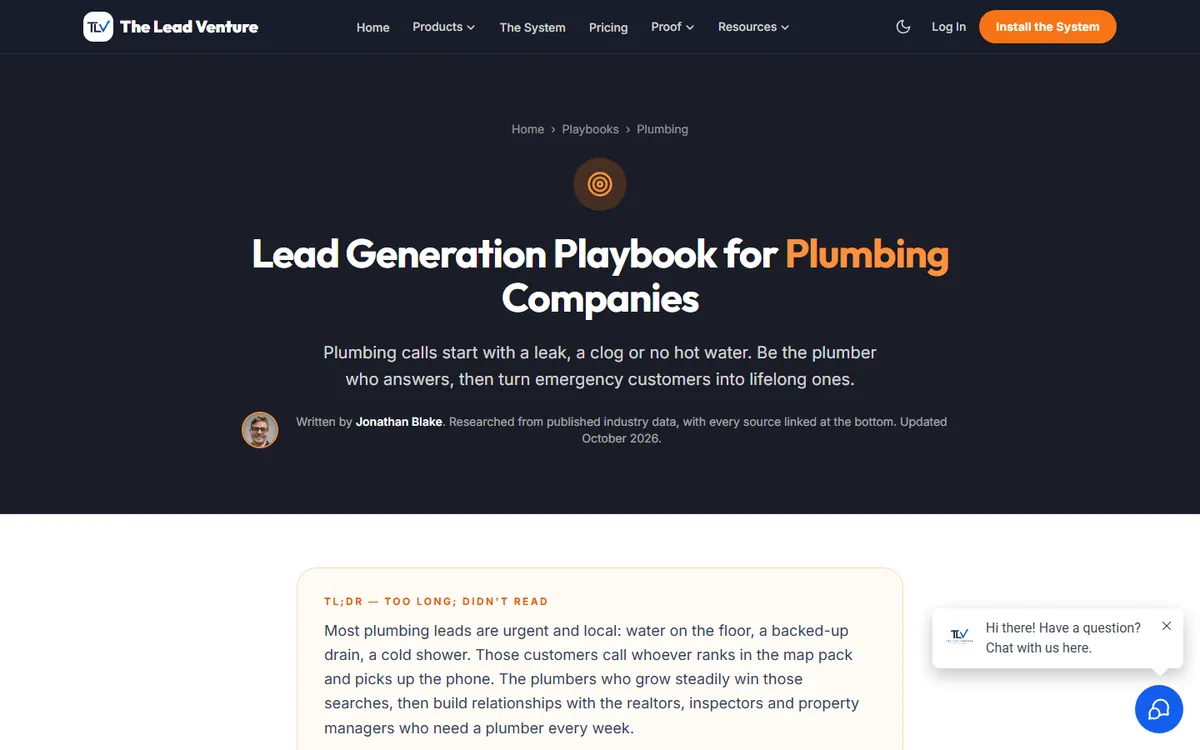 The Lead Venture’s plumbing lead generation playbook, November 2026.
TLV plans start at $97 a month, the full system is $297 a month, you pay $0 until it is live, and there are no contracts. You can read the details and decide:
- The Booked Solid System
- TLV’s plumbing lead generation playbook
- How TLV works with plumbing companies
If you would rather build it yourself, everything in this post works without TLV. The free website template is a decent starting point for the booking page.
Quick wins
Want clients this month? Start here
Set up your own house first. One clear offer for one niche, a simple site, a booking link and your own HighLevel account running the same automations you'll sell. Prospects trust what they can try.
Start with people who already know you
Past employers, old customers, friends who own businesses. Tell them exactly what you set up for plumbing companies and ask for 20 minutes.
Do daily outreach
Calls, emails and DMs to a tight list in one niche. Volume and follow-up beat clever copy.
Demo, don't describe
Build a quick AI agent or missed-call text-back demo in your own HighLevel account and let them try it on the call.
Post what you build
Short screen recordings of real automations. One a day on the platform your buyers use.
Partner with people who own your buyers
Web designers, bookkeepers and software resellers already have the relationship. Trade introductions.
Answer every lead in under a minute
Practice what you sell. Set up your own speed-to-lead automation first.
Work a local area in person
- Pick one area and walk into ten businesses in a row. Ask for the owner, keep it to two minutes and leave a card.
- Bring a one-page printout that shows the problem you fix (missed calls, slow follow-up, no reviews) with their name on it.
- Go back a week later. Most first visits are about being remembered, not closing.
Ask for introductions, not referrals
"Know anyone who could use this?" gets a polite "I'll think about it." Asking to be introduced to a specific kind of person gets names. Set it up when they sign:
"If this works the way I think it will, would you be against introducing me to one or two other plumbing companies you know? I'll give them a a free missed-call audit."
Then follow up once they're seeing results. With a client you get along with, a little humor works:
"So are you keeping me a secret on purpose, or do you just not like your friends?"
Only joke like that with clients you know well. With everyone else, keep it simple and thank them either way.