 Jonathan Blake
If you searched for the best CRM for plumbers, you probably have one of two problems. Either calls are slipping through the cracks, or the jobs are a mess once they are booked. Those are different problems, and different tools solve them.
I sold face to face since 2015, ran a tree service for six years, and now co-own The Lead Venture, an agency that runs on HighLevel. Plumbing and tree work share one painful habit: the phone rings when your hands are full, and the customer who needs help right now will not wait.
Short answer: if your bigger problem is deep dispatch, scheduling and invoicing, look at a field service tool like ServiceTitan, Housecall Pro or Jobber. If your bigger problem is missed calls and slow follow-up, I recommend GoHighLevel, because it puts the CRM, texting, missed-call text back, reviews and AI in one account. Many plumbers run both, and with HighLevel’s new Field Services module in beta, one account is worth testing.
Why plumbing companies lose leads
Plumbing is urgent, high-trust and local. The customer often has water on the floor. These are the leaks I see most:
- Nobody answers under the sink. The owner is under a house, the tech is on a job, and the office is one person on another line. The call goes to voicemail, and most people don’t leave a message.
- After-hours calls go nowhere. Emergencies don’t keep business hours. If the call at 9 pm is not answered or texted back, the customer picks the next plumber.
- Estimates for bigger jobs go quiet. Repipes, sewer lines and bathroom remodels get a quote and then silence. Without a follow-up, they sit.
- Nobody asks for the review. The customer was thrilled you showed up on a Sunday, and you never asked. The competitor with more reviews gets the click.
- A dead customer list. Years of past water heater installs and repairs sit in an invoice app. Those people will need you again, and you never reach out.
An emergency plumbing lead has a shelf life of about one phone call, and the plumber who texts back first usually gets the job. Where those leads come from is its own question, and I compared every plumbing lead source.
Customer lifetime value calculator
Plug in your own numbers. The starting values are examples, not data about your business.
-
Lifetime revenue
Add your numbers
-
Lifetime gross profit
Add your numbers
-
Rule-of-thumb max to win one customer
Add your numbers
Do this today: look at your phone log from last week and count missed calls after 5 pm. That number tells you how much a missed-call text back could be worth.
The best CRM for plumbers: 4 options compared
I’m not going to pretend one tool wins for everyone. Here is how I see them. I have not listed competitor prices because they change and depend on team size, so check each vendor’s pricing page before you decide.
GoHighLevel
- Strength: Missed-call text back, texting, follow-up, reviews, AI, reactivation
- Weak spot: Field Services (dispatch, invoicing, job costing, price books, accounting sync) is still in beta, so test it before you rely on it
- Pricing: Flat, from $97/month
ServiceTitan
- Strength: Full operations platform for larger trades companies
- Weak spot: Heavy for a small shop to set up and run
- Pricing: Check current pricing
Housecall Pro
- Strength: Scheduling, dispatch, invoicing and payments for home services
- Weak spot: Marketing automation is lighter
- Pricing: Check current pricing
Jobber
- Strength: Simple quotes, scheduling and invoicing
- Weak spot: Less depth for larger dispatch teams
- Pricing: Check current pricing
| Item | GoHighLevel | ServiceTitan | Housecall Pro | Jobber |
|---|---|---|---|---|
| Built for plumbing | No, general local business | Yes, trades | Yes, home services | Yes, home services |
| Missed-call text back and texting | Built in | Check current features | Check current features | Check current features |
| Dispatch and scheduling | Calendar and tasks, plus map dispatch and route optimization in Field Services (beta) | Strong | Strong | Strong |
| Invoicing and payments | Per-visit invoices and payments in Field Services (beta) | Strong | Strong | Strong |
| Review requests and AI | Built in | Check current features | Check current features | Check current features |
| Best fit | Owner who wants fewer lost calls | Larger multi-truck companies | Small to mid-size shops | Small shops wanting simplicity |
Features change, so treat this as a starting point and ask each vendor for a demo on your real workflow.
Who each one fits
ServiceTitan fits larger plumbing and trades companies that want one deep system for call booking, dispatch, pricing books and reporting. It asks a lot of a small shop.
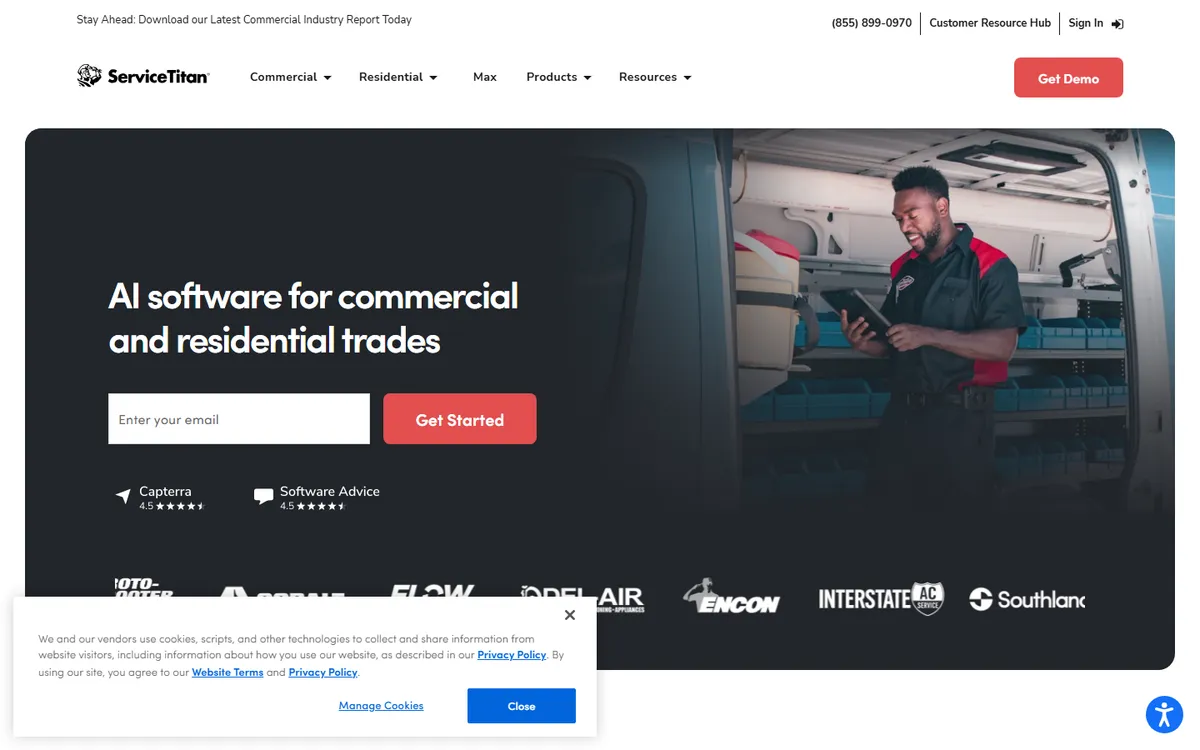 ServiceTitan homepage, November 2026.
Housecall Pro fits owner-operators and smaller crews who want scheduling, dispatch, invoices and payments in an app that techs can use on their phones.
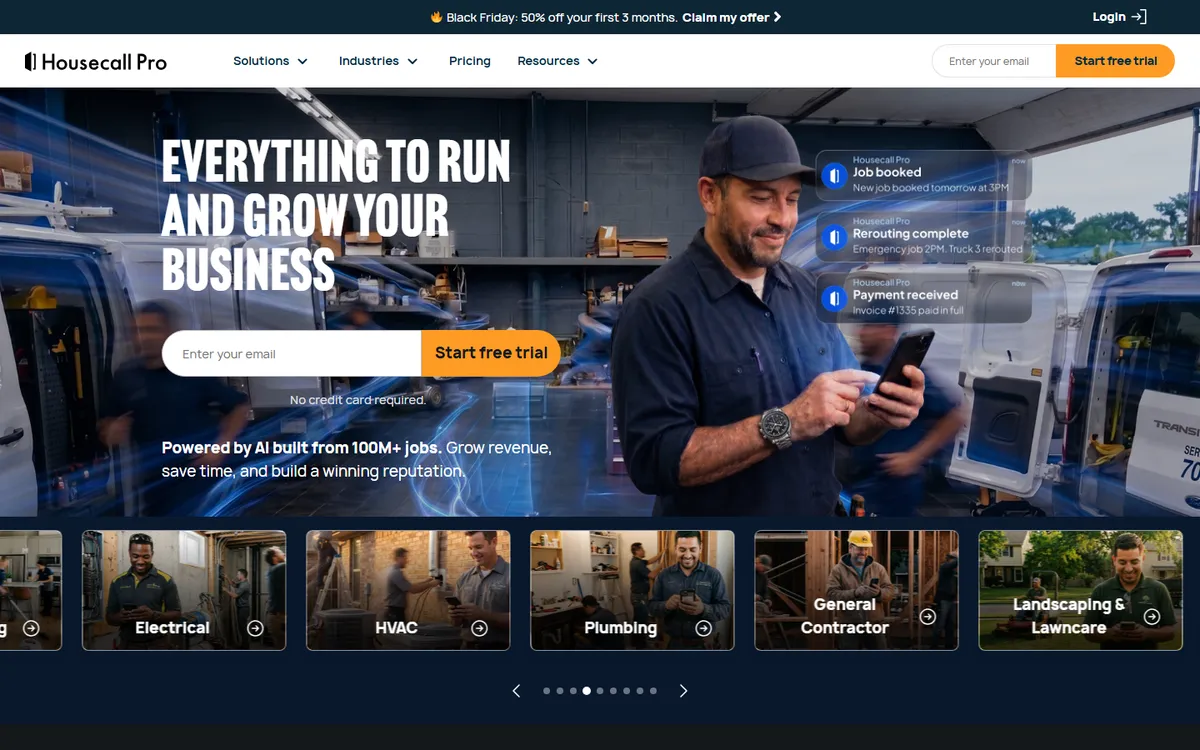 Housecall Pro homepage, November 2026.
Jobber fits a smaller plumbing shop that wants simple quoting, scheduling and invoicing without a big learning curve.
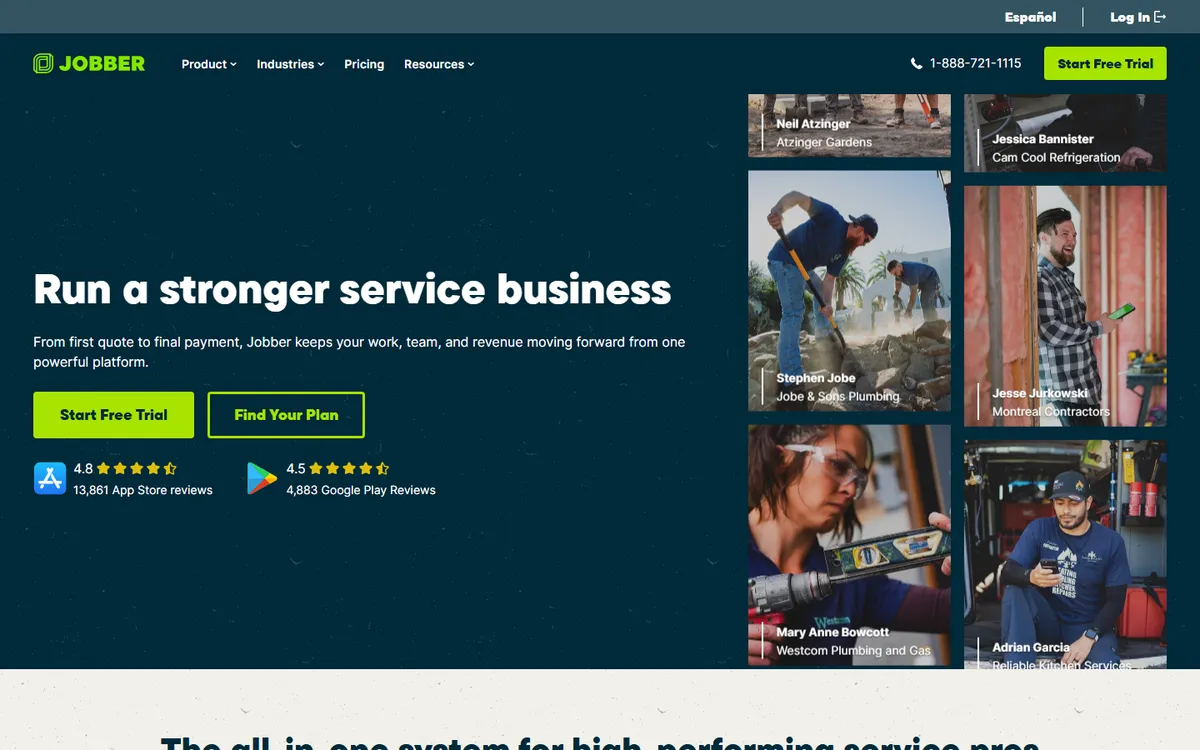 Jobber homepage, November 2026.
GoHighLevel fits the owner whose problem is the front end: getting the call answered, the lead texted, the job booked and the follow-up done. It also fits agencies that serve plumbers. See my full GoHighLevel CRM breakdown for what is inside it and where it falls short.
My recommendation
Your dispatch software tells you where the truck is. It does not tell you who called and gave up.
For most owner-operators and small crews, the leak is the first minute after a call is missed. That is why I recommend GoHighLevel for the front end: one account handles your CRM, your phone number, texting, missed-call text back, review requests and an AI agent that can answer questions and book jobs after hours.
The catch is maturity: GoHighLevel’s job and dispatch tools only just arrived, and it now has a built-in Field Services module, currently in beta, and it names plumbing. I loaded it into a new sub-account on 2026-11-16. It has booking requests, estimates that become jobs, jobs with multiple visits, scheduling that accounts for drive time and service areas, dispatch with calendar and map views, route optimization, a crew app with checklists, notes, timers and timesheets, and per-visit invoicing and payments. Snapshots load into it. Founder plan accounts already have it, and others request beta access. It also includes job costing, price books, accounting sync (for example QuickBooks) and payroll. There is no built-in good, better, best quote option, but you can build one manually with three line-item options on the estimate. For a small plumbing company it is a real all-in-one option worth testing in a second sub-account. Mature field tools still win on years of edge cases, deeper multi-year reporting and established integrations, which is why many plumbers run both, with the field tool running the trucks and GoHighLevel filling them. Check the pricing breakdown so you know what usage costs on top of the plan.
Do this today: write down your top two problems (missed calls, estimate follow-up, dispatch, reviews). Choose the tool that fixes the first one.
Start your free HighLevel trial 30-day trial · cancel anytime · keep the bonuses I may earn a commission if you sign up through my link, at no extra cost to you. DetailsHow to set up GoHighLevel for a plumbing business
This is the build I would do for a plumbing company. Give yourself a weekend. If you want the platform explained first, start with the GoHighLevel CRM guide.
1. Pipeline stages in plumbing words
Go to Opportunities and create a pipeline called “Plumbing Jobs.” Use stages you already say out loud:
- New Lead
- Contacted
- Emergency / Same-Day
- Job Booked
- Estimate Sent
- Follow-Up
- Approved
- Job Complete / Review Asked
- Maintenance / Reminder List
- Lost
Add custom fields for job type (emergency repair, water heater, drain or sewer, remodel or repipe), lead source, and water heater install year. That last one powers your best reactivation campaign.
2. The booking calendar
Create a calendar called “Book a Plumber.” Set the length (60 to 90 minutes), the days and hours you actually work, and a travel buffer so two calls don’t stack across town. Turn on confirmation and reminder messages, and send the booking notification to your phone. Add a separate “Emergency Call Back” calendar or task for after-hours leads so someone owns them first thing in the morning.
3. One request form
Build a short form for your site and ads: name, mobile number, address, “What’s going on?” (leak, no hot water, clog or drain, new install, other), an “Is this an emergency?” yes or no, and a consent checkbox for texting. Keep it to six fields. Every extra field costs you leads. When submitted, it should create the contact, create an opportunity (in Emergency if they said yes), and trigger the speed-to-lead workflow.
4. Five automations that pay for themselves
Missed-call text back. Trigger: inbound call, no answer. The full workflow is in my missed-call text back guide. For after-hours calls, add a version that mentions when you will call back.
Speed-to-lead reply. Trigger: form submitted or a lead from your ads. Send a text in seconds, notify your phone, and create a task to call within 5 minutes.
Booking reminders and no-show recovery. Send a confirmation, a reminder the day before, and a text an hour before with a “we’re on our way” note. If nobody is home, text within 15 minutes.
Estimate follow-up. Trigger: opportunity moves to Estimate Sent. Text after 1 day, 3 days and 7 days, and stop the moment they reply or move stages.
Water heater replacement reactivation. Filter contacts by water heater install year or by past water heater jobs. Send a gentle check-in to anyone whose unit is getting older, then a reminder two weeks later.
5. Reviews
When an opportunity moves to Job Complete, wait two days, then send a review request with your Google review link. If there is no reply, send one reminder a week later. Keep it a single ask, no pressure.
6. An AI agent for after hours
Set up a Conversation AI bot to answer texts and web chat when you are on a job or asleep. Give it a short script: ask what is going on, ask whether it is an emergency, collect the address, offer the next openings, and hand off to you for anything about price, gas smells or flooding. Tell it to say that anyone with a gas smell should leave and call their utility or emergency services. Review the first week of conversations and tighten the instructions. Never let it quote prices or diagnose problems.
7. Test everything
Submit your own form, call from a second phone and let it ring, book a job, and move a test opportunity through each stage. Fix anything that doesn’t fire before real leads arrive.
Do this today: build the pipeline and the missed-call text back first. They take under an hour and they protect your most valuable calls.
Texting rules for plumbers
This is not legal advice. Register for A2P 10DLC before you send business texts in the US. Include opt-out language, get texting consent on your form, and honor STOP immediately. Reactivation texts should go to people who have done business with you, not to purchased lists. Check your state’s rules for solicitation and quiet hours, and keep late-night texts to people who just contacted you.
For the phone side, my plumbing answering service guide compares live services and AI receptionists and has a copy-paste prompt.
Two ways to get this
Path 1: your own HighLevel account. You build it yourself using this guide.
Start your 30-day extended free trial 30-day trial · cancel anytime · keep the bonuses I may earn a commission if you sign up through my link, at no extra cost to you. DetailsPath 2: prefer it set up for you? My Growth Plan is $97 a month: white-label HighLevel already set up for local service businesses, so you skip the build. See the details on the bonuses page.
If you also work in the trades, my CRM for roofers guide follows the same build. And if you are an agency owner thinking about serving plumbers, see my notes on the best niches for a GoHighLevel agency.
Quick wins
Want clients this month? Start here
Set up your own house first. One clear offer for one niche, a simple site, a booking link and your own HighLevel account running the same automations you'll sell. Prospects trust what they can try.
Start with people who already know you
Past employers, old customers, friends who own businesses. Tell them exactly what you set up for plumbing companies and ask for 20 minutes.
Do daily outreach
Calls, emails and DMs to a tight list in one niche. Volume and follow-up beat clever copy.
Demo, don't describe
Build a quick AI agent or missed-call text-back demo in your own HighLevel account and let them try it on the call.
Post what you build
Short screen recordings of real automations. One a day on the platform your buyers use.
Partner with people who own your buyers
Web designers, bookkeepers and software resellers already have the relationship. Trade introductions.
Answer every lead in under a minute
Practice what you sell. Set up your own speed-to-lead automation first.
Work a local area in person
- Pick one area and walk into ten businesses in a row. Ask for the owner, keep it to two minutes and leave a card.
- Bring a one-page printout that shows the problem you fix (missed calls, slow follow-up, no reviews) with their name on it.
- Go back a week later. Most first visits are about being remembered, not closing.
Ask for introductions, not referrals
"Know anyone who could use this?" gets a polite "I'll think about it." Asking to be introduced to a specific kind of person gets names. Set it up when they sign:
"If this works the way I think it will, would you be against introducing me to one or two other plumbing companies you know? I'll give them a a free missed-call audit."
Then follow up once they're seeing results. With a client you get along with, a little humor works:
"So are you keeping me a secret on purpose, or do you just not like your friends?"
Only joke like that with clients you know well. With everyone else, keep it simple and thank them either way.