 Jonathan Blake

If you searched for roofing lead generation, you are probably in one of two spots. Either the phone is quiet and you need work, or you are paying for leads and not sure they are worth it. Both are fixable, but the fix is different.
I sold face to face since 2015, ran a tree service for six years, and now co-own The Lead Venture (TLV), an agency that runs lead systems for home service businesses. In the tree business I lived the storm-season call flood: the phone rings nonstop for three days, then goes quiet. Roofing works the same way, only the jobs are bigger and the competition is louder.
Short answer: the best roofing leads come from a mix. Build the cheap sources first (your Google profile, reviews, referrals, past customers), add one paid source like Google Local Services Ads or Google Ads, and fix what happens after a lead arrives. That last part is where most roofers quietly lose the money they already spent.
How to get more roofing leads: the honest map
Every guide on how to get more roofing leads lists the same eleven places. What they skip is the trade-off for each. Here is the whole map before we go deeper. I have kept cost qualitative on purpose. Ad prices change by city and season, and I would rather you check your own market than trust a number I made up.
| Lead source | Cost type | Speed to results | Lead quality | What it takes |
|---|---|---|---|---|
| Google Business Profile | Free, your time | Weeks to months | High, they are searching now | Complete profile, steady reviews, real photos |
| Local SEO website | Upfront build, then low ongoing | Months | High | Service pages by city, fast mobile site, a booking form |
| Google Local Services Ads | Pay per lead | Days to weeks | High intent, but you pay even for tire kickers | Verification, background checks, fast answers |
| Google Ads (search) | Pay per click | Days | High intent, depends on setup | Tracking, tight keywords, a landing page that converts |
| Facebook and Meta ads | Pay per lead or click | Days | Mixed, people were not searching | Good creative, fast follow-up, patience |
| Shared lead vendors (Angi, HomeAdvisor, Thumbtack) | Pay per lead, often shared | Immediate | Mixed, many competitors per lead | Instant response, price discipline |
| Exclusive leads | Pay per lead, higher | Fast | Usually better than shared | Vendor you trust, tracking |
| Door knocking and 12-pack canvassing | Mostly your time | Same day | Warm, you can point at your truck | Thick skin, a pitch, local rules |
| Referrals | Cheap, a small thank-you | Slow but steady | Highest, they trust you already | Ask every time, make it easy |
| Storm and seasonal campaigns | Varies | Fast, then it ends | High urgency, high competition | Be ready before the storm hits |
| Past-customer reactivation | Almost free | Days | Warm | A list and a follow-up system |
Now the part that tells you which row is for you.
The free and cheap sources (start here)
Google Business Profile
When a homeowner searches “roofer near me,” the map results usually show up before the website results. Your Business Profile is what appears there. Google says its local results are based mainly on relevance, distance and prominence, and a complete, accurate profile helps with all three.
What to do: pick the right primary category, list every service you actually do, set your service area honestly, add real job photos each month, and answer every question and review. A profile with a hundred real reviews and fresh photos beats a profile that has not been touched in two years.
The catch: it is slow, and it is not something you finish. It is a habit.
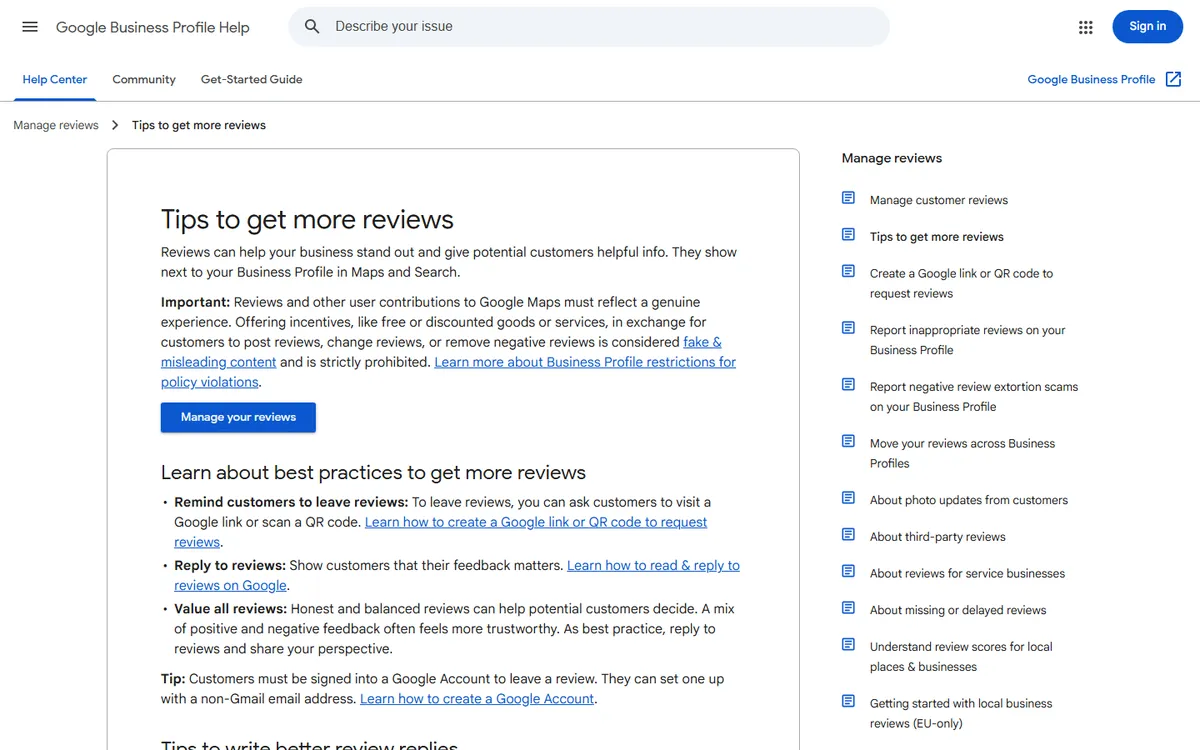 Google’s help article on getting more reviews. Note the rule against offering anything in exchange for a review, November 2026.
A local SEO website
Your website is where a profile click turns into a call or a form. For roofing it needs three things: a page for each service (repair, replacement, storm damage, insurance claims), a page for each city or area you really serve, and an easy way to book a free inspection. Make the phone number tap-to-call and keep the form to about five fields.
The mistake I see most is a pretty site that does not tell a worried homeowner what to do next. If you want a starting point, there is a free 31-page website template in the tools below.
Referrals
Referrals close at the highest rate because the homeowner already trusts you. They also happen less than you think, because most roofers never ask. The ask is simple: when the job is done and the customer is happy, say “if you know anyone who needs a roof or repairs, I’d appreciate you sending them my way.” Then make it easy with a card or a text they can forward.
Door knocking and the 12-pack
After a job, walk the twelve houses around it. You have a truck out front, a crew on the roof and a real address to point at. Introduce yourself, offer a free inspection, and leave a door hanger. This works because homeowners can see the proof, and it works best after storms.
Two cautions. Check your city and HOA rules on soliciting, and respect no-soliciting signs. And never tell a homeowner their roof is damaged when you have not looked at it. That is how roofers earn the reputation the rest of us have to fight.
Past-customer reactivation
Your best list is people who already hired you, plus everyone who got a quote and did not sign. A short text or email every quarter, something like “we are booking free roof check-ups after the recent weather,” wakes up work you already paid to find. I wrote about the full play in my database reactivation guide.
The paid sources (fast, but read the fine print)
Google Local Services Ads
Local Services Ads sit at the very top of local search and show a Google badge (the page I checked says “Google Verified”) in many markets. You pay per lead, not per click, and Google verifies your business first. Availability depends on your area and trade, so check Google’s current requirements for your market.
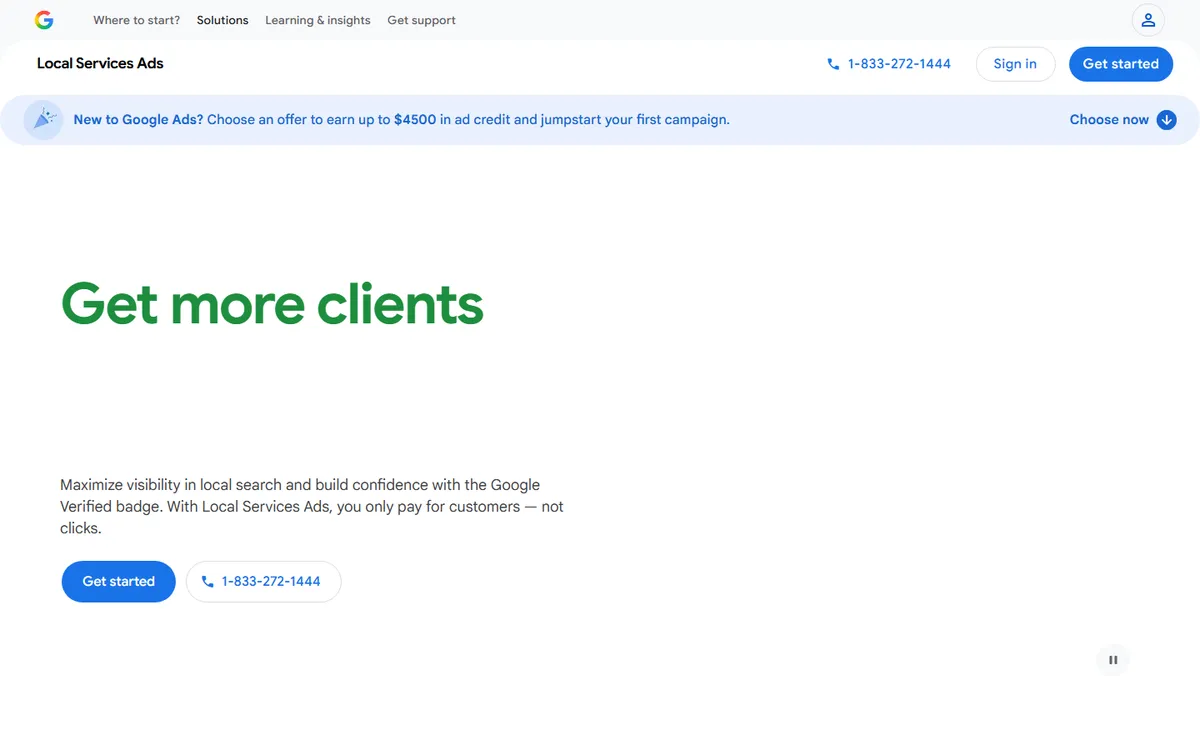 Google’s Local Services Ads page, November 2026.
What it takes: license and insurance checks, background checks, and fast answers, because response speed affects how you rank. Quality is high because people are actively looking, but you can still pay for leads that were never a fit, so dispute those.
Google Ads (search)
Search ads put you in front of someone typing “roof leak repair near me” at the exact moment they need you. It is the fastest way to get roofing leads on a schedule. It is also the easiest way to burn money if tracking is off, the keywords are loose, or the landing page does not convert.
What it takes: conversion tracking for calls and forms, tight keywords with negatives (so you stop paying for “roofing jobs” and “roofing supplies”), and a landing page built for one action. If you cannot say how many of last month’s clicks became calls, you are not ready to scale this.
Facebook and Meta ads
Meta ads reach people who were not searching, so intent is lower. The upside is reach and price flexibility, and it works well for storm follow-up in a defined area and for retargeting people who visited your site. The downside is that leads from a quick form on Facebook go cold fast, and many never answer.
What it takes: strong before-and-after creative, a short form, and an instant text reply. If you cannot reply within minutes, skip Meta for now.
Shared lead vendors versus exclusive leads
Angi, HomeAdvisor and Thumbtack sell leads, and many of them are shared with several contractors. That means the homeowner’s phone starts ringing the moment they submit, and you win on speed or price. Exclusive leads go to one contractor, cost more per lead, and usually convert better.
I will not tell you shared leads never work. Some owners make them pay by answering in seconds and tracking closed jobs. Others find the cost per signed roof is far too high. The rule I give everyone: start small, track every lead to a signed or lost job, and cut the source if it does not pay after a fair trial.
Storm and seasonal campaigns
Storm work is a rush. Homeowners call three or four roofers in one afternoon, and the one who answers and shows up first gets the inspection. The prep is what matters: have your ad copy, landing page, text templates and calendar ready before the weather arrives, not after. When a storm hits and you scramble, you pay peak prices and answer slowly.
Seasonal work is quieter but steady: pre-winter checks, post-summer inspections, gutter and flashing tune-ups.
What happens after the lead arrives
This is the part most lead generation guides skip, and it is where I see roofers lose the most money. You can pick the perfect source and still lose the job in the first ten minutes.
A lead you paid for and answered late is the most expensive lead you will ever buy. Homeowners do not wait. They send the same request to a few roofers and talk to whoever picks up first. I covered the research and the full workflow in my speed to lead guide, and the short version is that the first response should come within minutes, not hours.
Here is what I would put in place before spending another dollar on leads.
1. Never miss a call without a reply. You are on a roof, the office is one person, and the phone rings through to voicemail. A missed-call text back sends an automatic text the second a call goes unanswered, so the homeowner knows you saw it and can tell you what they need. For storm weeks, a human or AI answering line on top of that helps, and I wrote up the setup in my roofing answering service guide.
2. Reply to every web and ad lead in seconds. Not minutes. An automatic text that says who you are, what happens next and offers two inspection times beats a call back that comes the next morning.
3. Follow up on estimates. Most quotes sit because nobody touches them again. A text after one day, three days and a week, stopping the moment they reply, brings back jobs you already won half of.
4. Ask for the review. Two days after the job, send one request with your Google review link. Reviews feed your Business Profile, which feeds your next round of leads.
5. Track the source. Every lead needs a tag for where it came from, and every job needs the same tag at the end. Without it you cannot tell which source pays.
A CRM that holds all of this in one place makes it easier. I broke down the options in my CRM for roofers guide.
The math: cost per lead versus cost per signed roof
Cost per lead tells you what you paid to start a conversation. Cost per signed roof tells you whether the business works.
Here is an example you can redo with your own numbers. These are made-up round numbers to show the method, not benchmarks for your market.
| Step | Source A (cheap leads) | Source B (pricier leads) |
|---|---|---|
| Monthly spend | $2,000 | $2,000 |
| Cost per lead | $40 | $100 |
| Leads | 50 | 20 |
| Share that book an inspection | 20% | 50% |
| Inspections | 10 | 10 |
| Share that sign | 25% | 40% |
| Signed roofs | 2.5 | 4 |
| Cost per signed roof | $800 | $500 |
Source A looked cheaper per lead and turned out more expensive per roof. The numbers that move it are how many leads you actually reach, how many book, and how many sign, and those depend almost entirely on your response and follow-up.
To redo it: divide spend by leads for cost per lead, multiply leads by your booking rate and then your close rate to get signed roofs, and divide spend by signed roofs. If you want to skip the spreadsheet, the site’s calculators do the math for you.
Cost per lead calculator
Plug in your own numbers. The starting values are examples, not data about your business.
-
Cost per lead
Add your numbers
-
Cost per customer
Add your numbers
Which source fits which roofer
You do not need all eleven. A rough way to choose:
- Brand new or slow season: Business Profile, reviews, canvassing and past customers. Almost no ad money.
- Steady but flat: Add Local Services Ads or Google Ads with tracking, and fix your follow-up.
- Storm market: Build a storm kit now (landing page, texts, ad copy, calendar) and run Meta or search ads when the weather hits.
- Crews sitting idle: Reactivate past customers and canvass first. They bring jobs fastest at the lowest cost.
- Tempted by shared leads: Run a small, tracked test and judge by signed roofs.
Your first 30 days
| Week | Do this | Done when |
|---|---|---|
| Week 1 | Claim and complete your Google Business Profile, fix your phone and hours, add 15 real job photos, list every service | Profile is complete and photos are live |
| Week 1 | Turn on missed-call text back and write your first-reply text | A test call you miss gets a text within seconds |
| Week 2 | Ask your last 30 customers for reviews, and text 25 past customers about roof check-ups | 10 or more new reviews requested and replies tracked |
| Week 2 | Add a five-field quote form and a tap-to-call button to your site | You can submit the form and it alerts your phone |
| Week 3 | Set up estimate follow-up texts at day 1, 3 and 7 | A test estimate triggers all three |
| Week 3 | Walk the 12 houses around your next completed job | Door hangers out and any inspections booked |
| Week 4 | Pick one paid source, set a small test budget and tag every lead by source | Tracking works and you know the cost per lead |
| Week 4 | Review: calls missed, response time, inspections booked, quotes sent, roofs signed | You have a number for cost per signed roof |
Want this done for you?
I will be straight about this: I co-own The Lead Venture, so I have a stake in what comes next. TLV runs lead systems for home service businesses, including roofers. The system handles the parts above: it answers missed calls with a text, replies to new leads fast, follows up on estimates and asks for reviews.
 The Lead Venture’s roofing lead generation playbook, November 2026.
TLV plans start at $97 a month, the full system is $297 a month, you pay $0 until it is live, and there are no contracts. You can read the details and decide:
If you would rather build it yourself, everything in this post works without TLV. The free website template is a decent starting point for the booking page.
Quick wins
Want clients this month? Start here
Set up your own house first. One clear offer for one niche, a simple site, a booking link and your own HighLevel account running the same automations you'll sell. Prospects trust what they can try.
Start with people who already know you
Past employers, old customers, friends who own businesses. Tell them exactly what you set up for roofing companies and ask for 20 minutes.
Do daily outreach
Calls, emails and DMs to a tight list in one niche. Volume and follow-up beat clever copy.
Demo, don't describe
Build a quick AI agent or missed-call text-back demo in your own HighLevel account and let them try it on the call.
Post what you build
Short screen recordings of real automations. One a day on the platform your buyers use.
Partner with people who own your buyers
Web designers, bookkeepers and software resellers already have the relationship. Trade introductions.
Answer every lead in under a minute
Practice what you sell. Set up your own speed-to-lead automation first.
Work a local area in person
- Pick one area and walk into ten businesses in a row. Ask for the owner, keep it to two minutes and leave a card.
- Bring a one-page printout that shows the problem you fix (missed calls, slow follow-up, no reviews) with their name on it.
- Go back a week later. Most first visits are about being remembered, not closing.
Ask for introductions, not referrals
"Know anyone who could use this?" gets a polite "I'll think about it." Asking to be introduced to a specific kind of person gets names. Set it up when they sign:
"If this works the way I think it will, would you be against introducing me to one or two other roofing companies you know? I'll give them a a free missed-call audit."
Then follow up once they're seeing results. With a client you get along with, a little humor works:
"So are you keeping me a secret on purpose, or do you just not like your friends?"
Only joke like that with clients you know well. With everyone else, keep it simple and thank them either way.