 Jonathan Blake

If you have been shopping for a CRM, every product page says “cloud-based” like it is a feature. It is not a feature anymore. It is the default. What you actually need to know is what it means, what it costs you in control, and what to check before you hand your customer list to someone else’s servers.
I have sold face to face since 2015, ran a tree service for six years, and now co-own The Lead Venture, an agency that runs on HighLevel. When I ran the tree service, my “CRM” was a paper notebook, a calendar and a lot of memory. Moving to a cloud tool was the first time I could pull up a customer from my phone on a job site. That convenience is the real reason cloud won.
I am a HighLevel affiliate and I make money if you sign up through my link, so weigh that. I will tell you who it does not fit.
Short answer: a cloud-based CRM is software the vendor hosts, which you use through a browser or app for a monthly fee. For nearly every small business it beats on-premise software on cost, speed and effort. Pick one by what you need it to do (texting, pipeline, industry fit) and check four things first: login security, user permissions, backups and data export.
Cloud vs on-premise, in plain English
Think of it as renting vs owning a building.
Cloud-based (rent). The vendor owns the servers. You log in from anywhere. They handle updates, uptime and backups. You pay monthly. If you stop paying, you lose access, so you want to know how to export your data.
On-premise (own). You buy or lease the servers, install the software, and your IT person or provider keeps it running and patched. You pay a larger upfront cost, then ongoing maintenance. You have more direct control over where the data sits.
| Item | Cloud-based CRM | On-premise CRM |
|---|---|---|
| Where it runs | Vendor’s servers | Your own servers |
| How you pay | Subscription, monthly or annual | Upfront license or hardware, plus upkeep |
| Setup time | Minutes to days | Weeks to months |
| Updates and backups | Vendor handles them | You handle them |
| Access from phone or job site | Built in | Needs extra setup |
| Who it fits | Almost every small business | Organizations with strict data rules and an IT team |
Cloud means someone else keeps the lights on, and you still lock your own doors. That second half is the part owners forget. The vendor secures the building. You decide who gets a key, and whether they use a strong password.
Why cloud wins for small businesses
Four reasons, from what I have seen with local businesses.
- You can use it from the truck. A tradesperson, a realtor or a salesperson works away from a desk. A cloud CRM on a phone is the difference between answering a lead in a minute and answering at dinner.
- There is no IT person. Most small businesses do not have one. Cloud removes the server, the patching and the nightly backup from your list.
- You can start small. Many cloud CRMs have a free plan or a trial. You can find out whether you will use it before you pay for a year.
- New features show up on their own. The vendor ships updates and everyone gets them.
The trade-offs are real. You depend on the vendor staying in business and keeping prices fair. You depend on your internet connection. And per-seat pricing can climb as your team grows.
Start your free HighLevel trial 30-day trial · cancel anytime · keep the bonuses I may earn a commission if you sign up through my link, at no extra cost to you. DetailsWhat to look for in a cloud-based CRM
Skip the feature list for a minute. Ask these questions in this order.
- What happens when a lead comes in? Can it text back, notify you, create a deal and book a call without you touching it? Test with a form and your own phone.
- Does it work on my phone? Open the mobile app during the trial and try to reply to a text, move a deal and look up a contact.
- How is it priced? Per seat, flat, or by contact count? Per-seat is cheap with two people and expensive with ten. Flat pricing is the reverse.
- What are the extra costs? Texting, calling, email and AI often bill by usage on top of the plan. Ask what a normal month looks like.
- Can I get my data out? Ask how you export contacts, deals and notes. Ask how you get your data out before you ask how it gets in. Everybody shows you the import button, and the export button is the one that tells you how the vendor treats you.
- Does it fit my industry? A roofer, a lawyer and a realtor each have CRMs built for them. Check CRM by industry before you settle on a generic tool.
- How long is the learning curve? A tool that does a lot asks you to build a lot. Budget a week or two.
Security basics worth asking about
I am not a security engineer, and I will not pretend to certify anyone. These are the basics I check as a buyer, and I ask the vendor directly about each.
- Two-step login. Can you require a second code, not just a password, for every user? Turn it on the day you start.
- User permissions. Can you limit what each person sees and does? A new hire does not need to export the whole customer list.
- Backups. Does the vendor back up your data, and can you also export your own copy? Do both. A CSV export once a quarter is cheap insurance.
- Encryption. Ask whether data is encrypted in transit and at rest. A reputable vendor can answer this in one sentence.
- Audit trail. Can you see who changed what and when? That matters the day a record goes missing.
- Offboarding. When an employee leaves, can you shut off their access in one click?
- Your own habits. Use a password manager, do not share logins, and remove old users.
If you text customers from the CRM, there are consent and registration rules on top of security. In the US, business texting requires registration (A2P), and you need to honor opt-outs. Read the vendor’s guidance, and ask a lawyer if you are unsure.
A short list of cloud-based CRMs, with honest fits
I am only quoting prices I could see on the vendor’s own page in November 2026. Where I could not, I say “check current pricing.” For the full ranked version, read my best CRM for small business post.
| CRM | Best for | Starting price | Texting and calls | Biggest catch |
|---|---|---|---|---|
| GoHighLevel | Phone-driven local businesses and agencies | $97/month flat, unlimited users, plus usage | Built in | Learning curve and thinner reporting |
| HubSpot | In-house marketing and sales teams | Free for up to 2 users; paid per seat | Check current features | Cost grows with seats and tiers |
| Zoho CRM | Budget-minded owners | Free for up to 3 users; paid from $14 per user per month | Not the center | Per-user pricing, plainer feel |
| Pipedrive | Deal-focused sales teams | From $14 per seat per month, billed annually | Needs other tools | Per seat, fewer built-in channels |
| Salesforce | Larger teams with an admin | Check current pricing | Add-ons | Usually needs setup and upkeep |
GoHighLevel
Best for: local businesses and agencies that run on calls and texts and want the CRM, phone, booking and automations in one login.
As of late 2026, per HighLevel’s pricing page, Starter is $97 a month, Unlimited is $297 and the $497 plan adds SaaS mode, all with unlimited users and contacts. Usage is billed on top. My pricing breakdown has the details, and my CRM guide shows what is inside.
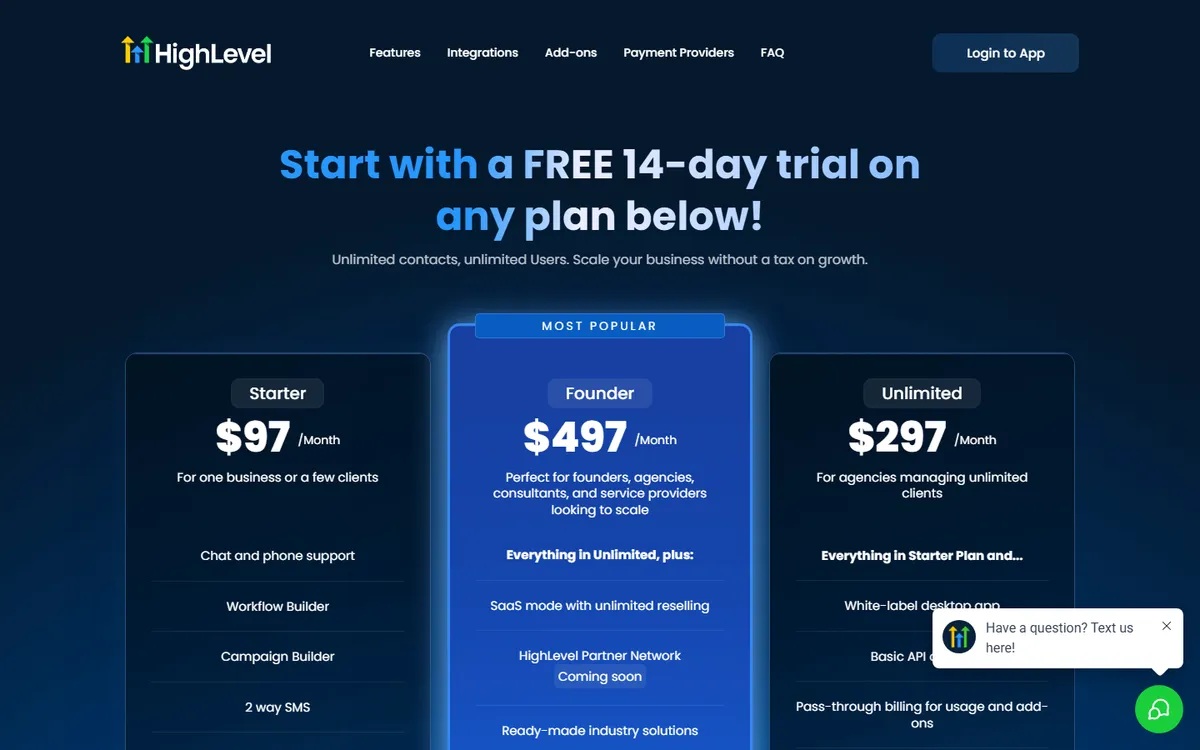 HighLevel’s pricing page, November 2026.
Skip it if: you are an in-house B2B sales team that wants the deepest reporting, or you will not spend a week or two setting it up.
HubSpot
Best for: in-house marketing and sales teams, and anyone who wants to start free.
HubSpot’s pricing page lists a free plan for up to 2 users. Paid plans are priced per seat and rise by tier, and some higher tiers carry onboarding fees. If you only need contacts and deals, free may be enough for a while.
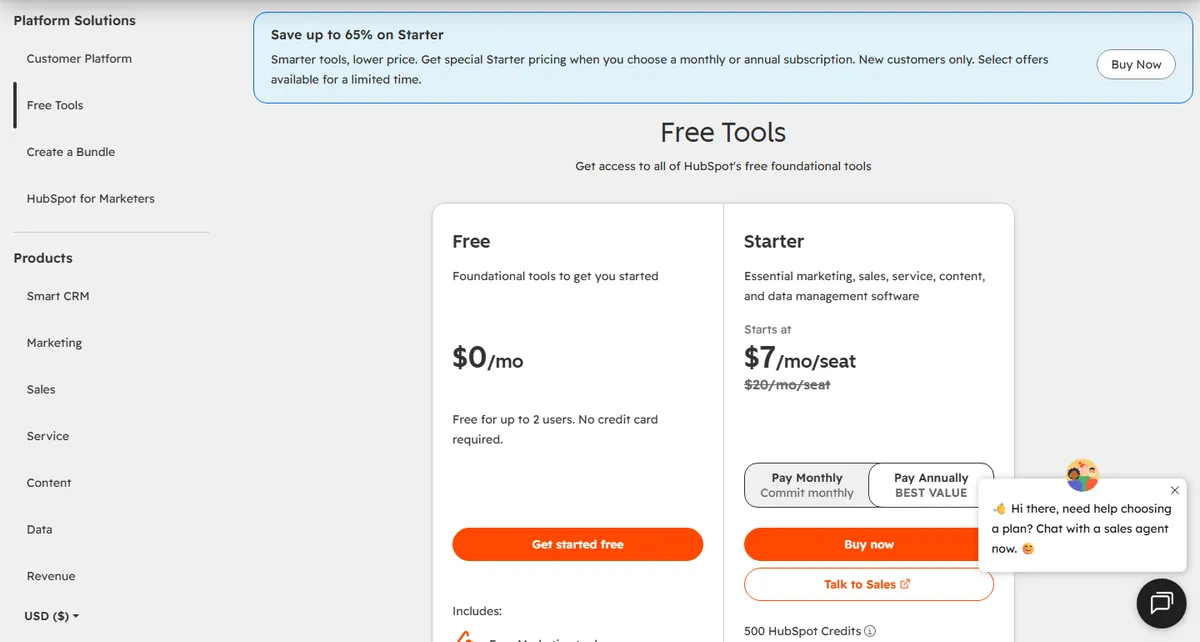 HubSpot’s pricing page, November 2026.
Skip it if: texting and calling are the center of how you sell. See HubSpot alternatives and GoHighLevel vs HubSpot.
Zoho CRM
Best for: owners who want a low-cost, customizable CRM and a free plan to start.
Zoho lists a forever-free plan for up to 3 users, and its paid tiers ran from $14 to $40 per user per month on annual billing on the page I checked. It is a real CRM, and it sits inside a big family of Zoho apps.
Skip it if: you want texting and phone at the center. More in Zoho CRM alternatives.
Pipedrive
Best for: a salesperson or small team that thinks in deals and stages.
The page I checked listed plans from $14 to $79 per seat per month billed annually. The board is easy to learn, and it does not try to be a marketing platform.
Skip it if: you need funnels, texting and bigger automations in the same tool. See Pipedrive alternatives.
Salesforce
Best for: larger teams with an admin and complex reporting needs.
It is extremely capable and not a casual purchase. For a small business, check current pricing and plan for setup time. If you are leaving it, my Salesforce alternatives post is for you.
Quick comparison
GoHighLevel
- Pricing style: Flat, unlimited users
- Skip if: You need top-tier reporting
HubSpot
- Pricing style: Free tier, then per seat
- Skip if: Texting is key
Zoho CRM
- Pricing style: Free tier, then per user
- Skip if: You want built-in phone
Pipedrive
- Pricing style: Per seat
- Skip if: You need marketing tools
How to test a cloud CRM in one afternoon
- Sign up for the free plan or trial. Do not enter your whole customer list yet.
- Add 20 real contacts with a tag.
- Build a pipeline with five stages that match how you actually sell.
- Submit your own web form and see what happens: do you get a notification, a text, a deal?
- Open the mobile app and reply to a lead from your phone.
- Find the export button and download your 20 contacts.
- Turn on two-step login for your account.
If a tool cannot pass those seven steps in an afternoon, it will not pass them in a busy month. I wrote about the mindset behind this in my CRM examples post, and my software alternatives page covers moving between tools.
Pick this week
- If your leads come by phone and text and you want one flat bill, start a trial of GoHighLevel. HighLevel’s standard trial is 14 days, and my link gives a 30-day extended free trial.
- If you want free and simple, try HubSpot’s or Zoho’s free plan.
- If you only track deals, try Pipedrive.
Write down the one thing that made you start looking, whether that is speed to reply, price or complexity, and pick the tool that fixes it first.
Quick wins
Want clients this month? Start here
Set up your own house first. One clear offer for one niche, a simple site, a booking link and your own HighLevel account running the same automations you'll sell. Prospects trust what they can try.
Start with people who already know you
Past employers, old customers, friends who own businesses. Tell them exactly what you set up for small businesses picking a cloud CRM and ask for 20 minutes.
Do daily outreach
Calls, emails and DMs to a tight list in one niche. Volume and follow-up beat clever copy.
Demo, don't describe
Build a quick AI agent or missed-call text-back demo in your own HighLevel account and let them try it on the call.
Post what you build
Short screen recordings of real automations. One a day on the platform your buyers use.
Partner with people who own your buyers
Web designers, bookkeepers and software resellers already have the relationship. Trade introductions.
Answer every lead in under a minute
Practice what you sell. Set up your own speed-to-lead automation first.
Work a local area in person
- Pick one area and walk into ten businesses in a row. Ask for the owner, keep it to two minutes and leave a card.
- Bring a one-page printout that shows the problem you fix (missed calls, slow follow-up, no reviews) with their name on it.
- Go back a week later. Most first visits are about being remembered, not closing.
Ask for introductions, not referrals
"Know anyone who could use this?" gets a polite "I'll think about it." Asking to be introduced to a specific kind of person gets names. Set it up when they sign:
"If this works the way I think it will, would you be against introducing me to one or two other small businesses picking a cloud CRM you know? I'll give them a free CRM security checklist."
Then follow up once they're seeing results. With a client you get along with, a little humor works:
"So are you keeping me a secret on purpose, or do you just not like your friends?"
Only joke like that with clients you know well. With everyone else, keep it simple and thank them either way.