 Jonathan Blake

Searches for “AI voice agency” are everywhere right now, and most of what ranks is a course pitch. I’ll give you the version I’d follow if I were starting today. I’ve sold face to face since 2015, ran a tree service for six years, and now co-own The Lead Venture, where we run AI voice and text agents on HighLevel for clients.
If you want the broader plan for an AI agency of any kind, start with how to start an AI agency. This post is narrower. It’s only about selling AI voice agents, the AI receptionist that picks up the phone. To see how this model compares with a classic social media agency, read SMMA vs AI agency.
Short answer: an AI voice agency sets up AI phone agents for local businesses so every call is answered and the right ones are booked. Pick one niche, build one demo agent in HighLevel Voice AI, price it as a setup fee plus a monthly fee plus usage, and win clients by calling their own number live in front of them.
What an AI voice agency actually sells
A business owner doesn’t buy a voice agent. They buy the end of voicemail.
Here’s the offer in plain words: “Every call to your business gets answered in under three rings, 24 hours a day. Common questions get answered, and people who want an appointment get booked on your calendar. Anything tricky goes to you.”
That’s an AI receptionist for a small business, and it breaks into four deliverables:
- Answering. The agent picks up every call, including after hours and when all lines are busy.
- Qualifying. It asks two or three questions so you know who’s calling and why.
- Booking. It puts the appointment on a real calendar, and the booking shows up in the client’s CRM.
- Handoff. It transfers or flags a human for anything urgent, upset or unusual.
You are not selling “AI.” You’re selling fewer missed calls and fuller calendars. Write your one-liner before you build anything: “I make sure [niche] never miss a call again.” If you want to see how owners compare the options, I wrote about human vs AI virtual receptionists.
Which niches answer the phone constantly
The best niches for voice have three traits: the phone rings all day, the person who should answer is busy with a customer, and one booked call is worth a few hundred dollars or more.
I’m keeping this list away from contractors and home trades, because that’s the lane The Lead Venture already works in. Here are better places to start if you want your own lane:
- Med spas and aesthetics. Front desk is busy with a client, calls come in during treatments, and a consult is worth real money.
- Dental and orthodontic offices. New patient calls pile up at lunch and after close.
- Law firms (personal injury, family, estate). A missed intake call usually goes to the next firm on Google.
- Salons and barbershops. Stylists can’t answer with their hands full, and most callers just want a time slot.
- Auto repair shops. The owner is under a car. Callers want a quote range and a drop-off time.
- Property management. Maintenance requests and leasing questions at all hours.
- Real estate teams. Buyer and seller leads call from signs and listings, often on weekends.
Pick one. Then do ten minutes of homework: call five businesses in that niche at lunch and after 5 p.m. and count how many answer. That number is your pitch.
Step 1: build a demo agent in HighLevel Voice AI
I use HighLevel because the phone number, calendar, CRM and Voice AI live in one account. A booked call shows up as a contact and an appointment without any glue between tools. If you don’t have an account yet, the 30-day extended free trial through my link gives you time to build and test a real demo before the standard 14 days would run out.
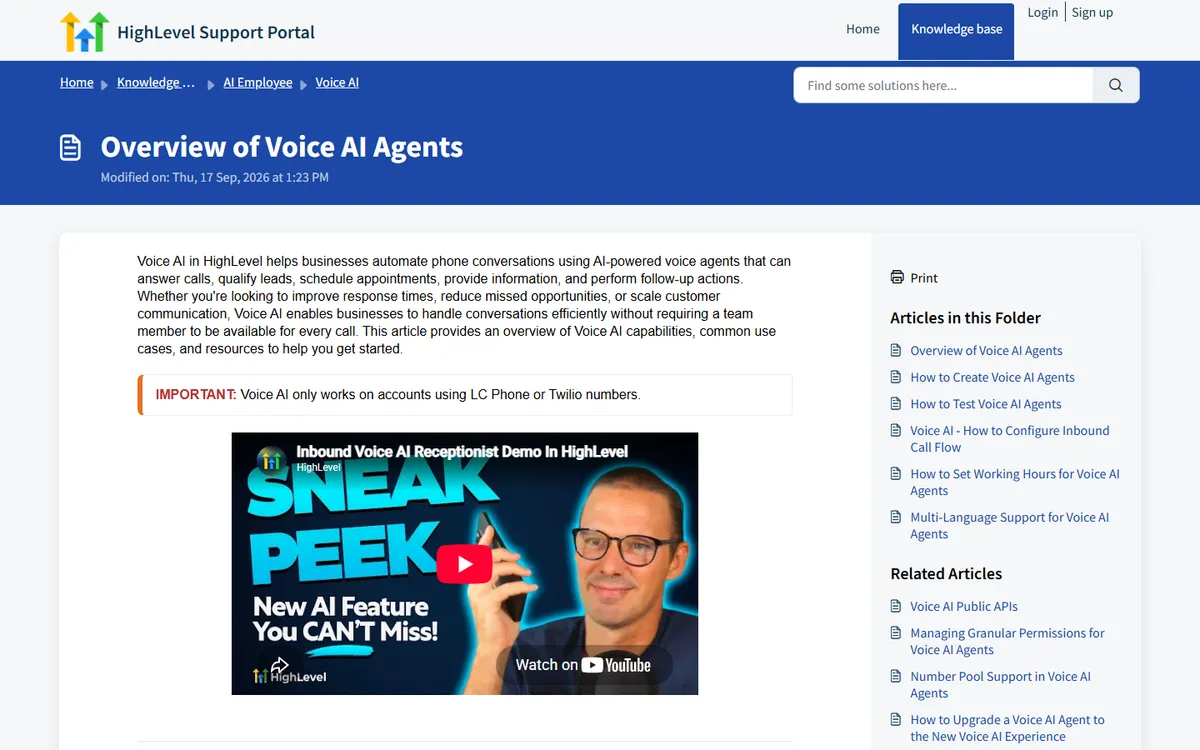 HighLevel’s Voice AI overview. Note that Voice AI only works on LC Phone or Twilio numbers, November 2026.
My GoHighLevel AI agents guide covers the full Voice AI setup. Here’s the short version for a demo:
- Get a phone number live. Buy a local number in the sub-account and make sure a real inbound call rings through.
- Create a booking calendar. Add two or three fake services with realistic durations and availability.
- Create the Voice AI agent. Menu names shift as HighLevel updates the product, so look for the AI agents or Voice AI section of the sub-account.
- Paste your prompt (sample below) and add a short knowledge base: hours, services, price ranges, what the business does not do.
- Set the actions. Book an appointment, collect a callback number, tag the contact, and transfer to a human line.
- Point the number at the agent and call it from your own phone.
Step 2: the agent prompt that works
Most bad voice agents have a bad prompt: too long, too vague, and written in corporate language. Keep it short, give it one job, and tell it what to do when it doesn’t know.
Here’s the structure I use. Swap in the details of your niche. This one is for a fictional med spa.
ROLE
You are the front desk assistant for Glow Studio Med Spa in Austin, Texas.
Your job: answer calls, answer simple questions, and book consultations.
You are an AI assistant. If asked, say so plainly.

TONE
Warm, brief, calm. One or two sentences at a time. No jargon.
Never talk for more than 15 seconds without asking a question.

OPENING
"Thanks for calling Glow Studio, this is the virtual assistant.
I can help with questions or book a consultation. What can I do for you?"

QUALIFY (ask only what you need)
1. What treatment are you interested in?
2. Are you a new or returning client?
3. Do you have a day that works best this week?

BOOKING
Offer two specific times, never an open-ended "when works for you."
Confirm name, mobile number and time. Read the number back.
Then say a text confirmation is on its way.

KNOWLEDGE
Hours: Mon to Sat, 9 a.m. to 6 p.m.
Consultations are free and take 30 minutes.
Do not quote exact prices. Say "pricing depends on the treatment,
and the consultation covers it."
Do not give medical advice or promise results.

HANDOFF
Transfer to a human or take a message if the caller:
- is upset, mentions a complication or a medical concern
- asks for something not in your knowledge
- says "talk to a person" or asks twice for a human
Say: "Let me get someone on the team to help. Can I confirm the best
number to reach you?" Then tag the contact "needs-callback".

NEVER
Never guess. Never invent a price, a policy or an availability.
Never argue. Never keep a caller who wants to leave.
Three details make this work. The agent has a clear job, it offers two specific times, and the fallback is “I’ll get someone” instead of a confident wrong answer.
Step 3: the testing checklist
If your demo agent can’t survive a rude caller, it isn’t ready for a client. Run this list before every demo and every launch, and call from a phone the system doesn’t know.
- Happy path. Book a normal appointment start to finish. Check the calendar, the contact and the confirmation text.
- Booked slot. Ask for a time that’s already taken. It should offer another, not double book.
- Off-script question. Ask something outside the knowledge base. It should hand off, not guess.
- Price pressure. Say “just give me a ballpark.” It should stay inside the rules you gave it.
- Rude caller. Interrupt, swear, change your mind twice. It should stay calm and offer a human.
- Noisy line. Call from a car or a loud room. Check that it still catches your name and number.
- Wrong number or spam. It should end the call politely instead of looping.
- Human request. Say “let me talk to a person.” The transfer or callback tag must fire every time.
- After hours. Call outside business hours and check the agent says the right thing about hours and next steps.
Listen to the call recordings, not just the results. Half the fixes come from hearing where the agent sounded stiff.
Step 4: pricing and margin math
There are three parts: a setup fee, a monthly fee, and usage. Keep usage separate. It’s the part that scales with how busy your client is.
At The Lead Venture we sell AI voice and Conversation AI as an add-on at $197 a month plus usage. For a new voice agency I’d quote:
- Setup: $497 to $997 one time, covering the prompt, knowledge base, calendar, number and testing.
- Monthly: $197 for monitoring, prompt tweaks and support.
- Usage: billed per minute on top.
Now the real costs from HighLevel’s published rates as of late 2026. Voice AI speech-to-speech runs about $0.10 to $0.20 per minute pay-per-use, and an inbound call on LC Phone adds about $0.01165 per minute. So one minute of an AI-answered call costs you roughly $0.11 to $0.21.
Here’s a worked example for a client with 400 minutes of AI calls a month. If you bill usage at $0.30 per minute:
| Item | Low-cost rate | High-cost rate |
|---|---|---|
| Your cost per minute (AI + phone) | $0.11165 | $0.21165 |
| Your cost for 400 minutes | about $44.66 | about $84.66 |
| You bill (400 x $0.30) | $120 | $120 |
| Usage margin | about $75 | about $35 |
Pay per minute
- Your cost: Roughly $0.11 to $0.21 per minute
- Best for: Quiet clients and small call volume
AI Employee Unlimited
- Your cost: $97 per sub-account per month
- Best for: Clients who talk a lot
That margin sits on top of the $197 monthly fee. The flat alternative is an AI Employee plan: $50 per sub-account for 100 Voice AI minutes and 1,000 Conversation AI responses, or $97 for unlimited. For a client who talks a lot, the $97 unlimited plan can beat per-minute billing. Do the math per client.
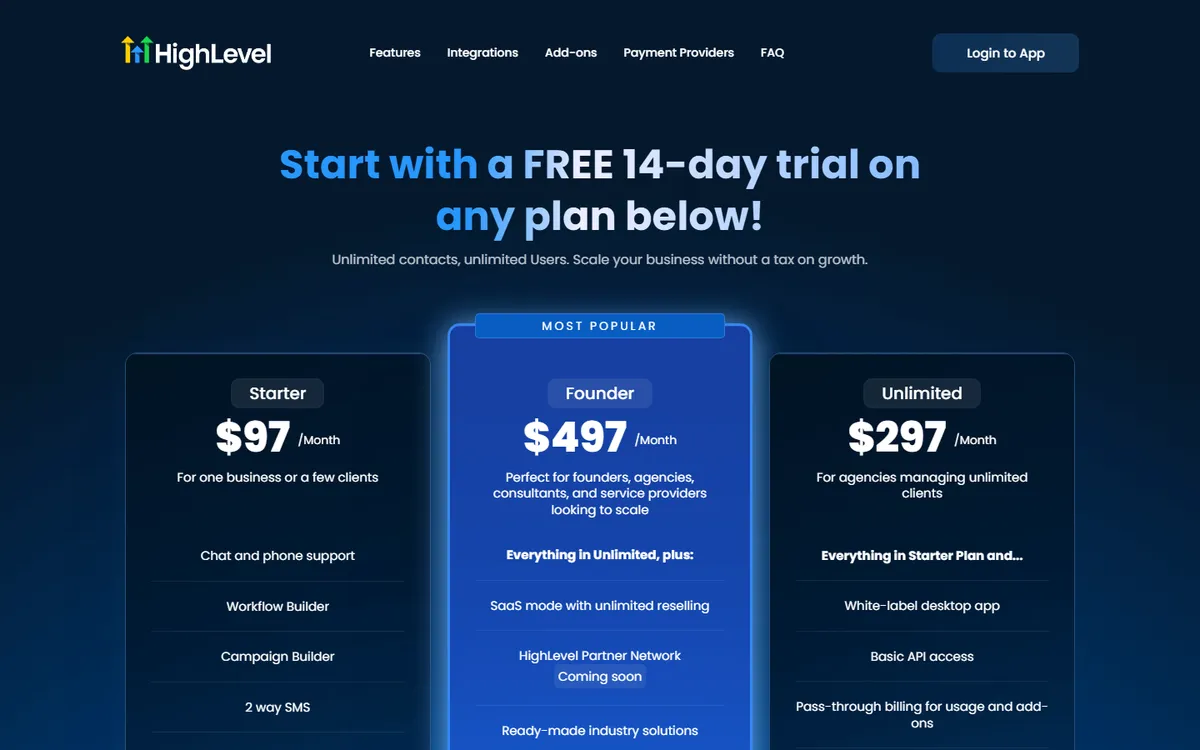 HighLevel’s pricing page, November 2026.
One catch on rebilling: on HighLevel’s Unlimited plan ($297) you can pass usage through at cost. To add your own markup you need the $497 plan. My pricing breakdown and SaaS mode guide walk through both.
Step 5: compliance basics
This isn’t legal advice, and the rules differ by state. These are the things I’d always handle:
- Disclose the AI. Have the agent say it’s a virtual assistant in the greeting and answer honestly if asked. Callers get angrier about being fooled than about talking to software.
- Call recording consent. Many states require everyone on the call to consent to recording. Add a line like “this call may be recorded to help us serve you” to the greeting, or turn recording off.
- TCPA and outbound. The FCC has ruled that AI-generated voices count as artificial voices under the TCPA, which generally means you need prior consent before an AI calls someone. I only sell inbound answering to new agencies. Outbound AI calling is a separate, riskier business.
- Sensitive industries. Med spas, dental and law firms have their own privacy rules. Tell the agent not to give medical or legal advice and keep sensitive details out of the transcript where you can.
- Put it in writing. Your client agreement should say who is responsible for recording notices and call content.
Step 6: get your first clients with a live demo
I spent ten years selling at the kitchen table, and the lesson is the same here: don’t explain, show. The pitch that works is not a deck.
- Call the business at lunch and let it ring. Note it. If someone answers, thank them and try again at 5:15 p.m.
- Book a 10-minute meeting with the owner: “I called your office yesterday at lunch and nobody picked up. I’d like to show you something that fixes that.”
- Demo on their own number. Forward their line to your demo agent, or set up a quick agent with their name and services. Call it in front of them.
- Say one sentence: “That’s every call you miss, handled starting today.”
- Offer a 30-day pilot. Fixed setup fee, monthly fee, cancel anytime after the pilot.
Start with your warm list: a dentist you know, the salon you go to, your own mechanic. Offer your first one or two a discounted build in exchange for a testimonial. Ten conversations will teach you more than any course.
If you’d like help getting a first agent built and tested, that’s a standard consulting project, or book a call. Everyone who signs up through my link also gets a free onboarding call: claim it here.
Quick wins
Want clients this month? Start here
Set up your own house first. One clear offer for one niche, a simple site, a booking link and your own HighLevel account running the same automations you'll sell. Prospects trust what they can try.
Start with people who already know you
Past employers, old customers, friends who own businesses. Tell them exactly what you set up for med spas and dental offices and ask for 20 minutes.
Do daily outreach
Calls, emails and DMs to a tight list in one niche. Volume and follow-up beat clever copy.
Demo, don't describe
Build a quick AI agent or missed-call text-back demo in your own HighLevel account and let them try it on the call.
Post what you build
Short screen recordings of real automations. One a day on the platform your buyers use.
Partner with people who own your buyers
Web designers, bookkeepers and software resellers already have the relationship. Trade introductions.
Answer every lead in under a minute
Practice what you sell. Set up your own speed-to-lead automation first.
Work a local area in person
- Pick one area and walk into ten businesses in a row. Ask for the owner, keep it to two minutes and leave a card.
- Bring a one-page printout that shows the problem you fix (missed calls, slow follow-up, no reviews) with their name on it.
- Go back a week later. Most first visits are about being remembered, not closing.
Ask for introductions, not referrals
"Know anyone who could use this?" gets a polite "I'll think about it." Asking to be introduced to a specific kind of person gets names. Set it up when they sign:
"If this works the way I think it will, would you be against introducing me to one or two other med spas and dental offices you know? I'll give them a a free AI receptionist demo on their own number."
Then follow up once they're seeing results. With a client you get along with, a little humor works:
"So are you keeping me a secret on purpose, or do you just not like your friends?"
Only joke like that with clients you know well. With everyone else, keep it simple and thank them either way.
An AI voice agency
Pros
- Clear offer: every call answered and the right ones booked
- Usage margin on top of a monthly fee
- No coding needed to build a demo
Cons
- Compliance and recording consent need real attention
- A busy client on flat pricing can eat your fee
- Needs a hard-tested agent before any client sees it
Common mistakes
- Starting with every niche. One niche, one set of FAQs, one demo. Add others later.
- A long prompt. Cut it in half. Every extra rule is another place it can go wrong.
- No human handoff. Build it before the first call, not after the first angry caller.
- Skipping the recordings. Review the first 20 calls for every new client.
- Flat pricing with no usage plan. See the margin math above.
For niche-ready prompts and call flows you can demo, use my AI receptionist guides by industry.
What to do next
Build your demo agent this week. Pick the niche, paste the prompt, run the testing checklist, and call five owners. If you want the wider business plan behind it, read how to start an AI agency.
Start your 30-day extended free trial 30-day trial · cancel anytime · keep the bonuses I may earn a commission if you sign up through my link, at no extra cost to you. Details