 Jonathan Blake
“White label” is one of those terms that gets thrown around until nobody’s sure what it means. In HighLevel it means something specific: your clients use the platform under your brand instead of HighLevel’s. If you want the wider picture of reselling software under your own brand, my white label SaaS post explains the model.
I co-own an agency that runs on HighLevel and serves home service businesses. Our clients log into a platform with our name on it. This post covers what white label includes, what it costs as of late 2026, how to set it up, and whether the mobile app add-on is worth paying for.
What “white label” means in HighLevel
White label in HighLevel covers four things:
- Your domain. Clients log in at something like app.youragency.com instead of a HighLevel address.
- Your branding. Your logo, colors, favicon and company name in the web app and login page.
- The desktop (web) app. The full platform your clients use in a browser, under your brand.
- The mobile app (optional). A branded app in the Apple App Store and Google Play with your name and icon. This is a separate add-on.
What white label doesn’t do on its own: it doesn’t sell anything, bill anyone or set up accounts for you. That’s SaaS mode.
What it costs
| Item | Starter ($97) | Unlimited ($297) | Founder plan ($497, includes SaaS mode) | Enterprise |
|---|---|---|---|---|
| White-label web app (your domain and branding) | No | Included | Included | Included |
| White-label mobile app | Not on this plan | $497/month add-on | $497/month add-on | Included |
| SaaS mode | No | No | Yes | Yes |
| Sub-accounts | 3 | Unlimited | Unlimited | Unlimited |
Prices as of late 2026, from HighLevel’s pricing page.
So the real entry point for white label is the Unlimited plan at $297 a month. The branded mobile app is where the cost jumps: $497 a month on top of your plan, unless you’re on Enterprise. If you would rather earn from HighLevel without reselling it, there is also the affiliate program.
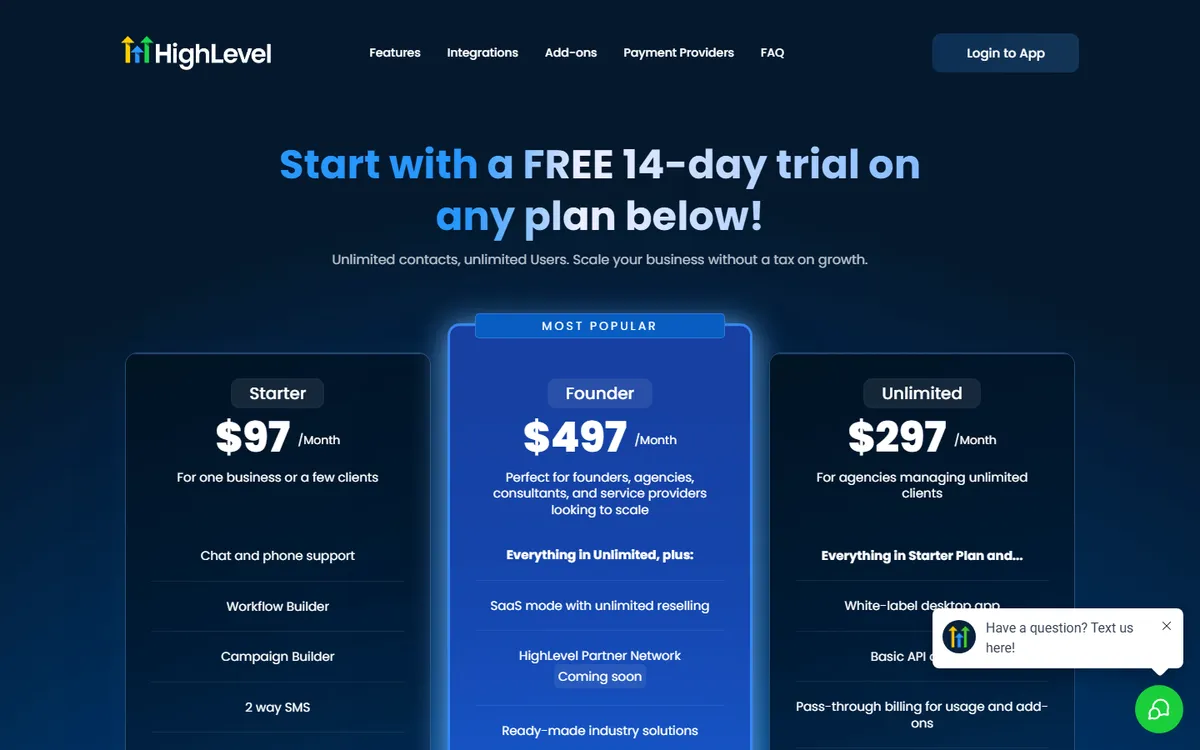 HighLevel’s pricing page, November 2026.
Starter
- Price: $97/month
- Sub-accounts: 3
- White-label web app: No
Unlimited
- Price: $297/month
- Sub-accounts: Unlimited
- White-label web app: Included
Founder plan
- Price: $497/month
- Sub-accounts: Unlimited
- SaaS mode: Yes
There are also small running costs that come with any setup: your domain, and the phone and email usage your client accounts generate. Those don’t change because of white label. My GoHighLevel pricing breakdown has every usage rate.
Start your free HighLevel trial 30-day trial · cancel anytime · keep the bonuses I may earn a commission if you sign up through my link, at no extra cost to you. DetailsStep-by-step white-label setup
HighLevel updates its settings screens often, so use their help center for exact clicks. This is the order I’d do it in.
1. Pick and connect your domain
Choose a subdomain of your agency’s site, like app.youragency.com. In your domain’s DNS settings, add the record HighLevel gives you in the agency settings, then add the domain in HighLevel. DNS changes can take a while to spread, so do this first.
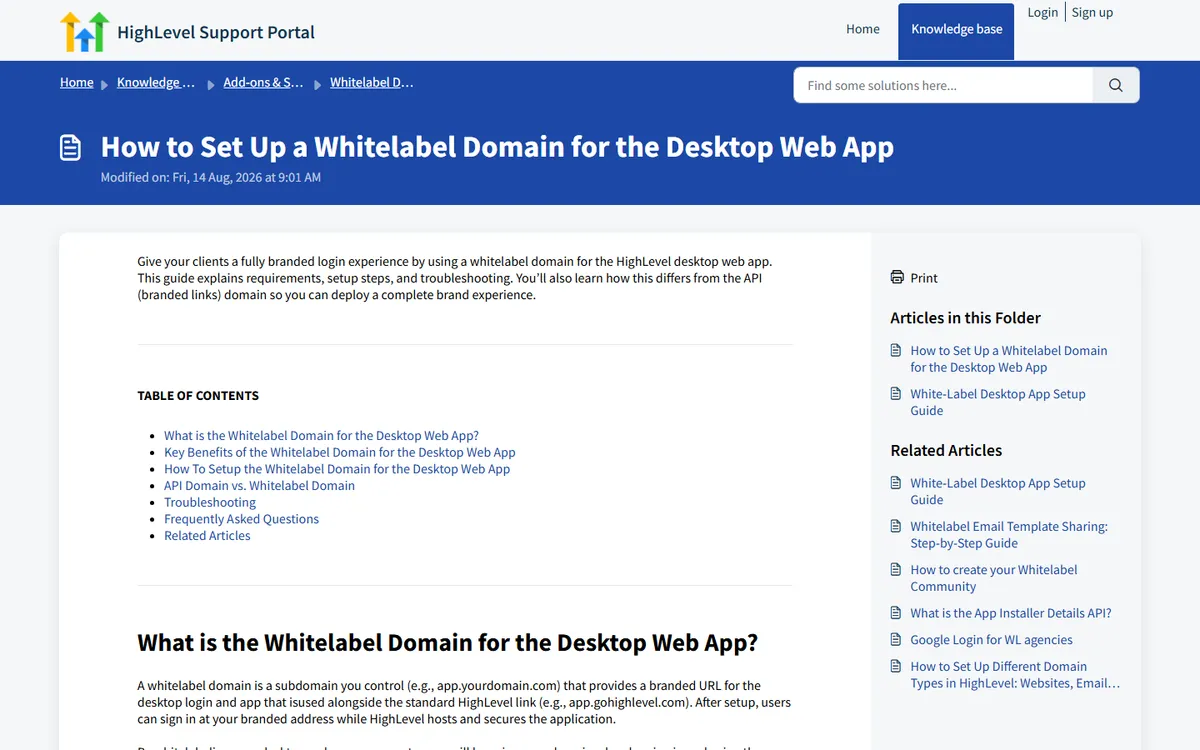 HighLevel’s guide to setting up a white-label domain, November 2026.
2. Upload your branding
Add your logo (a light and dark version if you have them), favicon, company name and brand colors in agency settings. Check the login page on desktop and on a phone. A blurry logo on the login screen is the first thing clients notice.
3. Set up email sending under your name
Set up a dedicated sending domain (for example, mail.youragency.com) so system emails and client campaigns come from your brand and land in inboxes. Do the same for each client’s own sending domain when you onboard them. Bad email setup is the most common reason a white-label platform feels cheap.
4. Set up your support path
Decide how clients get help: a support email, a help desk, a phone number or a booking link. Put it in the platform and in your onboarding emails. With white label, you are the support desk as far as your clients know.
5. Build a branded onboarding flow
A welcome email, a short video walking through the app, and a first call. If you use SaaS mode, this runs automatically after checkout.
6. Test as a client
Create a test sub-account, log in as a client user, and walk through it on a laptop and a phone. Look for anything that still shows a name you didn’t choose.
The white-label mobile app: is it worth it?
The branded mobile app puts your agency’s name and icon in the app stores. Clients download “Your Agency” instead of HighLevel’s standard LeadConnector app.
It’s worth paying for when:
- You have enough clients that $497 a month is a small share of revenue.
- Your offer is sold as your own software, and an app with your name helps close deals.
- Your clients live in the mobile app (most service business owners do).
It’s not worth it yet when you have a handful of clients. The standard LeadConnector app works fine. Most of our clients care that the missed-call texts go out and the reviews come in, not whose icon is on their home screen.
My rule of thumb: get the web app branded on day one, and add the mobile app when it would pay for itself with a couple of extra clients or a lower cancel rate.
The white-label mobile app
Pros
- Your agency's name and icon in the app stores
- Helps close deals when you sell it as your own software
- Fits clients who live in the mobile app
Cons
- $497 a month on top of your plan, unless you're on Enterprise
- Hard to justify with only a handful of clients
- The standard LeadConnector app works fine until then
How to present a branded platform to clients
Clients don’t care what software you use. They care that it looks like it belongs to someone they trust.
Here’s how I’d talk about it at the kitchen table, which is where I’ve done most of my selling since 2015:
- Lead with the result, not the software. “Every missed call gets a text back in seconds, and every finished job gets a review request.” Then show it on your branded app.
- Demo on their phone. Call their number from the demo, let it go unanswered, and let them watch the text arrive. That does more than any slide.
- Call it your platform, and be honest if asked. Saying “it’s our platform, built on HighLevel” is true and perfectly fine. Don’t claim you wrote the software.
- Keep the login simple. One URL, one password reset path, one support contact.
At The Lead Venture we sell two plans, Growth at $97 a month and Full Suite at $297 a month, plus an AI voice and Conversation AI add-on at $197 a month plus usage. Clients buy the plan for the results, and the branded platform makes the whole thing feel like one company instead of a pile of tools. These were my results based on my experience. Your results may be different.
Naming your platform
You don’t need a separate software brand. For most agencies, the agency name is the platform name, and that’s the simplest choice: one brand, one website, one login.
A separate platform name makes sense if you serve one niche and want the name to say so, or if you plan to sell the platform more widely with SaaS mode. If you go that way, keep it short, make sure the domain is available, and check that it isn’t someone else’s trademark. HighLevel’s affiliate and brand rules also mean you shouldn’t put HighLevel’s name in your own domain or product name.
Whatever you choose, use it everywhere: login page, emails, invoices, the app icon if you buy the mobile app, and the way you talk about it on sales calls.
What white label doesn’t hide
White label is good, but it isn’t invisible. A few places can still show HighLevel or LeadConnector names:
- The standard mobile app. Unless you pay for the white-label mobile app, clients use HighLevel’s LeadConnector app from the app stores.
- Some links and system pages. Depending on how things are set up, a link or page can show a HighLevel-related address.
- Phone and texting registration. Carrier registration (A2P 10DLC) is tied to the client’s business, and the paperwork may name the platform provider.
None of this is a problem if you’re upfront. Plenty of business owners are happy to hear “it’s our platform, built on HighLevel, and we run it for you.” What hurts trust is a client discovering it after you implied you built the software yourself.
Common white label mistakes
- Skipping email setup. System emails from a generic address look cheap and land in spam.
- A low-quality logo. It shows up on the login page, in the app and in emails. Use a clean, high-resolution file.
- No support path. With white label, clients come to you for everything. Decide how they reach you before they need to.
- Paying for the mobile app too early. $497 a month is a lot for a handful of clients. Wait until it pays for itself.
- Branding the platform but not the onboarding. If the first email after signup looks generic, the branding on the app doesn’t matter.
- Not testing on a phone. Most owners of service businesses will open your platform on their phone first.
White label for an AI agency
If you’re starting an AI agency, white label is what makes your AI offer feel like your own product. Clients log into your platform to see the conversations your Conversation AI handled and listen to calls your Voice AI answered. They don’t see a patchwork of tools.
At my agency, the AI voice and Conversation AI add-on runs inside the same branded platform as everything else. That keeps the story simple for the client: one company, one login, one bill. If you’re building that kind of offer, white label on the Unlimited plan is the minimum, and the Founder plan ($497) adds SaaS mode and lets you add your own markup when rebilling AI usage (Unlimited rebills it at cost). How to start an AI agency has the rest of that plan, and GoHighLevel AI agents covers the Voice AI and Conversation AI setup itself.
White label vs SaaS mode
These get mixed up constantly. White label changes what the client sees. SaaS mode changes how the client pays.
| Item | White label | SaaS mode |
|---|---|---|
| What it does | Your domain, logo and colors on the platform | Sell plans with automatic billing, account setup and usage rebilling |
| Plan needed (late 2026) | Unlimited ($297) or higher | $497 plan |
| Good for | Any agency that wants a professional, branded client experience | Agencies selling a repeatable, software-style offer |
| Needs Stripe | No | Yes |
You can use white label without SaaS mode. Most agencies start there. When your offer is repeatable enough to sell as fixed plans, add SaaS mode. I explain how in GoHighLevel SaaS mode explained.
If you’re still choosing a platform, white label is one of the clearest differences in GoHighLevel vs HubSpot. HubSpot doesn’t offer a white-label CRM. For the full picture, read my GoHighLevel review.
Quick wins
Want clients this month? Start here
Set up your own house first. One clear offer for one niche, a simple site, a booking link and your own HighLevel account running the same automations you'll sell. Prospects trust what they can try.
Start with people who already know you
Past employers, old customers, friends who own businesses. Tell them exactly what you set up for local service businesses and ask for 20 minutes.
Do daily outreach
Calls, emails and DMs to a tight list in one niche. Volume and follow-up beat clever copy.
Demo, don't describe
Build a quick AI agent or missed-call text-back demo in your own HighLevel account and let them try it on the call.
Post what you build
Short screen recordings of real automations. One a day on the platform your buyers use.
Partner with people who own your buyers
Web designers, bookkeepers and software resellers already have the relationship. Trade introductions.
Answer every lead in under a minute
Practice what you sell. Set up your own speed-to-lead automation first.
Work a local area in person
- Pick one area and walk into ten businesses in a row. Ask for the owner, keep it to two minutes and leave a card.
- Bring a one-page printout that shows the problem you fix (missed calls, slow follow-up, no reviews) with their name on it.
- Go back a week later. Most first visits are about being remembered, not closing.
Ask for introductions, not referrals
"Know anyone who could use this?" gets a polite "I'll think about it." Asking to be introduced to a specific kind of person gets names. Set it up when they sign:
"If this works the way I think it will, would you be against introducing me to one or two other local service businesses you know? I'll give them a free missed-call audit."
Then follow up once they're seeing results. With a client you get along with, a little humor works:
"So are you keeping me a secret on purpose, or do you just not like your friends?"
Only joke like that with clients you know well. With everyone else, keep it simple and thank them either way.
Bottom line
White label in HighLevel is simple: your domain, your branding, included from the $297 Unlimited plan as of late 2026. The mobile app is a $497-a-month add-on you can wait on. Get the domain, branding and email set up properly, test it like a client would, and present it as your platform with the results up front.
If you want help setting up white label, email and onboarding the right way, book a consulting call. If you want help building the offer you’ll sell on it, see my coaching. Or start with the 30-day extended free trial through my link and brand your first account.
Start your free HighLevel trial 30-day trial · cancel anytime · keep the bonuses I may earn a commission if you sign up through my link, at no extra cost to you. Details