 Jonathan Blake

“White label SaaS” sounds like a trick, and it isn’t. It’s an old model with a new name: someone else builds the software, you put your name on it, and you sell it. Plenty of agencies already do it without calling it that.
I co-own The Lead Venture, an agency that sells HighLevel-powered plans to home service businesses. I’m also a HighLevel affiliate. I’ll use HighLevel as the main example because it’s what I know, and I’ll cover other white-label categories more briefly so you can see the pattern.
Short answer: white label SaaS means you sell another company’s software under your own brand and price. You earn a recurring fee, and often a markup on usage. The tool is the easy part. The offer, the onboarding and the support are what customers pay you for.
What white label SaaS actually is
There are three pieces to it, and people mix them up.
- White label. The product shows your brand: your logo, your domain, your colors. The customer never needs to know who made the engine.
- Reselling. You sell access to it, set your own price, and bill the customer yourself.
- SaaS. The product is software delivered by subscription, not a one-off project.
Put them together and you get a company that looks like a software business to its customers, while the vendor handles the hard engineering. White label doesn’t make you a software company. It makes you a company that sells a result and happens to run it on someone else’s software.
That distinction matters because it affects what you promise. If you promise “our software,” you’re on the hook for features you don’t control. If you promise “missed calls get a text back in a minute and booked jobs get review requests,” you’re selling something you can deliver using any good tool.
How agencies make money with it
There are two revenue lines, and one cost line you don’t want to forget.
| Line | What it is | Who controls it |
|---|---|---|
| Subscription revenue | The monthly plan your client pays you | You set the price |
| Usage revenue | Texts, calls, email and AI, billed to the client with your markup | You set the markup, within the vendor’s rules |
| Platform cost | What you pay the vendor each month, plus usage | The vendor |
| Your time | Onboarding, support and fixing things | You |
The first three are on a spreadsheet. The fourth isn’t, and it’s the one that decides whether the model is profitable. A plan that looks great on paper can lose money if every client needs a two-hour call a month.
HighLevel SaaS mode: the main example
HighLevel has two separate features for this. They’re easy to confuse, so here’s the split.
- White label changes what the client sees. Your domain, logo and colors, in the web app. As of late 2026, it’s included on the $297 Unlimited plan and the $497 plan, per HighLevel’s pricing page. See my GoHighLevel white label guide.
- SaaS mode changes how the client pays. You create plans and prices, clients check out, pay you through Stripe, and get an account built from your snapshot. Usage can be rebilled with your markup. It’s on the $497 plan. See my GoHighLevel SaaS mode guide.
White label changes what the client sees. SaaS mode changes how the client pays.
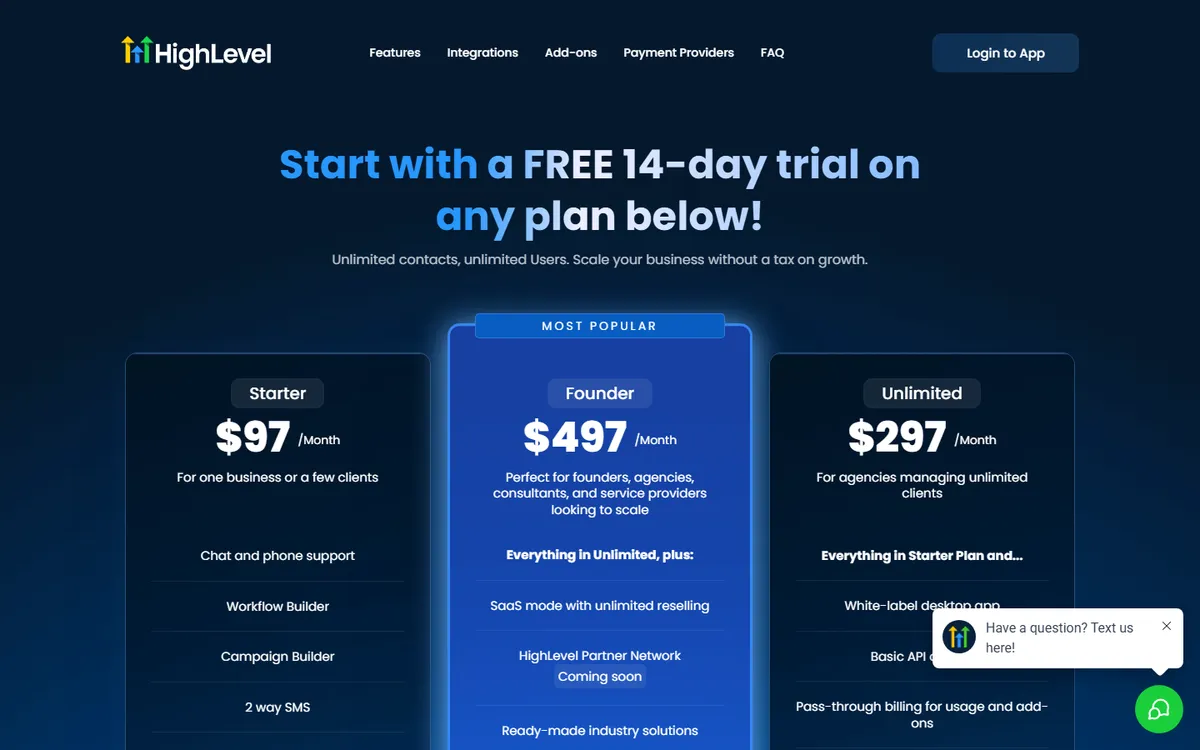 HighLevel’s pricing page, where SaaS mode sits on the Founder plan, November 2026.
| Item | Starter ($97) | Unlimited ($297) | Founder plan ($497) |
|---|---|---|---|
| White-label desktop app | No | Yes | Yes |
| Pass usage to clients at cost | No | Yes | Yes |
| Rebill usage with your markup | No | No | Yes |
| SaaS mode (plans, checkout, auto-provisioning) | No | No | Yes |
A branded mobile app in the Apple and Google stores is a separate add-on at $497 a month, as of late 2026. Most agencies don’t need it at first.
Start your free HighLevel trial 30-day trial · cancel anytime · keep the bonuses I may earn a commission if you sign up through my link, at no extra cost to you. DetailsThe economics, with real numbers
Here’s the worked example from my SaaS mode post. It uses HighLevel’s published US rates as of late 2026 and made-up usage for a busy home service client:
| Usage | Volume | HighLevel cost |
|---|---|---|
| SMS segments | 1,500 | $11.21 |
| Outbound call minutes | 600 | $9.96 |
| Inbound call minutes | 400 | $4.66 |
| Local phone number | 1 | $1.15 |
| Total | $26.98 |
If you rebill phone usage at twice HighLevel’s cost, the client pays about $54 and you keep about $27. Carrier and A2P fees come on top, and HighLevel applies a fixed 5% markup to those when rebilling is on.
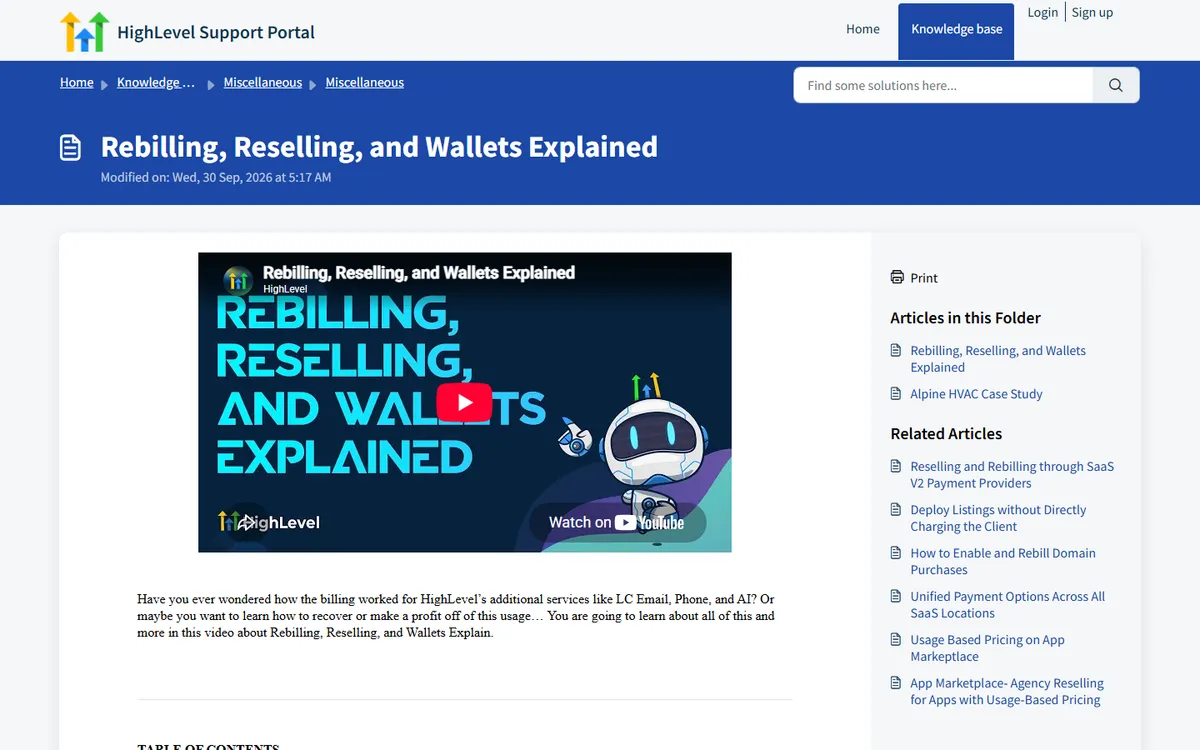 HighLevel’s help article on rebilling and wallets, November 2026.
That’s not much for one client. Across 30 clients it’s roughly $800 a month, which covers the $497 plan with room to spare. And that’s only the usage side. Your subscription fees come on top.
For reference, here’s how we price our plans at The Lead Venture:
| Plan | Price | How it’s built |
|---|---|---|
| Growth | $97/month | Our entry plan |
| Full Suite | $297/month | Our complete plan |
| AI add-on | $197/month plus usage | AI voice and Conversation AI, sold separately so usage never eats the base price |
These were my results based on my experience. Your results may be different. The point isn’t to copy our prices. It’s to see the structure: flat fees for predictable things, and usage passed through for things that vary.
Other white-label categories
HighLevel isn’t the only place this model shows up. Here are three other categories, described in general terms. I’m not naming vendors or quoting prices here, because they vary and I haven’t tested them side by side.
White-label reporting and SEO tools. Some vendors let agencies present rank tracking, site audits and reports under their own branding. The client sees your logo on a monthly report. The value is in the interpretation you add, not the dashboard.
White-label email and marketing platforms. Some email and marketing automation vendors offer reseller programs where an agency runs campaigns for clients under its own domain and brand. The agency usually pays per account or per volume and charges the client a bundled fee.
White-label AI tools. Voice agents, chat assistants and receptionists are sold the same way. The agency puts its name on the product, configures it for the client’s business, and bills for it. Usage costs are usually metered, so the rebilling question matters even more here. My GoHighLevel AI agents guide covers how HighLevel handles this.
| Category | What the client sees | Where margin comes from | Biggest risk |
|---|---|---|---|
| All-in-one platform (HighLevel) | Your CRM, texting, booking and automation under your brand | Subscription plus usage markup | Setup and support time |
| Reporting and SEO | Your branded reports and dashboards | Bundled fee over the vendor’s per-account cost | Reports clients don’t read |
| Email and marketing | Campaigns sent from your brand | Bundled fee over per-account or per-volume cost | Deliverability problems |
| AI voice and chat | An assistant carrying your name | Subscription plus metered usage | Usage costs you didn’t price in |
The pattern is the same everywhere. You’re paying for a tool, wrapping it in a result, and charging for the result.
What the client experiences
It helps to picture a white-label SaaS from the customer’s side, because that’s what you’re really building.
- They click a link on your site or in a text from you and land on a checkout page with your name on it.
- They pick a plan and pay with a card. The money goes to your account, not the vendor’s.
- They get a welcome email from you with a login to your branded app.
- Their account already has your pipelines, workflows, forms and calendars.
- When their account sends texts or makes calls, the cost comes out of their own wallet.
If any step feels clunky, clients notice. Walk through it yourself on your phone before you send the link to anyone. This is also where a good onboarding video and a clear support path earn their keep, since you are the support desk as far as your clients know.
Is white label SaaS right for you?
White label SaaS for an agency
Pros
- Recurring revenue instead of one-off projects
- Clients see your brand and stay with you
- Usage rebilling turns a cost into income
- A good snapshot can be copied for each new client
Cons
- You are the support desk as far as clients know
- You depend on a vendor's pricing and product changes
- Every new client still needs setup, like A2P texting registration
- Margins disappear if you skip rebilling or over-customize
A quick check. If you can answer yes to most of these, it’s probably worth trying:
- You already serve clients in one niche.
- You can describe your offer by the result it gets, not the software.
- You have, or can build, one setup that works for most clients.
- You can handle basic support yourself.
- You’re comfortable with usage-based costs.
If you’re answering no to most, fix the offer first. If you can’t explain your offer without naming the software, you don’t have an offer yet.
Mistakes that sink white label SaaS businesses
- Selling the software, not the result. Clients don’t buy features. They buy missed calls answered and jobs booked.
- Too many plans. Two or three is plenty. More choices slow people down.
- Skipping rebilling. You pay for usage you never charge for.
- Customizing every client. If every account is different, you’ve built a services business with a software label.
- Ignoring support. With white label, you are the support desk as far as your clients know.
- No test run. Sign up as a fake client, pay, log in and send a text before you sell the first plan.
- Forgetting texting registration. A2P registration takes time, and every client needs it.
How I’d start
- Pick one niche and write down the single problem you solve for them.
- Build one setup that solves it, and copy it with a snapshot. See my snapshots guide.
- Start on the Unlimited plan with white label if you want to serve clients under your name.
- Move to the $497 plan with SaaS mode once your offer is repeatable.
- Test the full signup as a fake client before you sell.
If you’d like help with the build, that’s a standard consulting project, or book a call. Everyone who signs up through my link also gets a free onboarding call: claim it here.
Start your 30-day extended free trial 30-day trial · cancel anytime · keep the bonuses I may earn a commission if you sign up through my link, at no extra cost to you. Details