 Jonathan Blake

I didn’t start a marketing agency. I started a tree service, got tired of being the lead, and built the thing I wished I’d had. Six years running that business taught me more about why most new marketing agencies fail than any course could have, because I was the customer before I was the agency.
Short answer: pick one niche you understand, build one offer around a real problem, set up your tech stack once (I use HighLevel), and get your first clients from your warm list and local outreach before you spend anything on ads.
Why most new agencies fail
Not because the market’s too crowded. Because of three things I see over and over:
- Generalist positioning. “I do marketing for small businesses” describes nothing and convinces nobody.
- No sales skill. A lot of new agency owners can build a funnel and can’t close a deal, and the second one is what actually pays the bills early on.
- Too many tools. Juggling five separate logins to deliver one offer slows everything down and makes handing off or scaling nearly impossible.
Nobody hires “a marketing agency.” They hire the person who fixed the exact problem that’s costing them money right now.
Step 1: pick a niche you understand
I picked home services because I’d lived it. For six years I ran a tree service and felt what it’s like to be up in a bucket truck while a lead goes cold because nobody could answer the phone. When I started pitching agency services to businesses like mine, I wasn’t guessing at their problems. I’d had them.
That’s the real test for a niche, more than market size: can you describe the business’s biggest problem better than they can describe it themselves? If you can, your pitch writes itself and your case studies are believable because you’ve actually been there.
You don’t need my exact niche. Pick one you understand from real experience, even a part-time job or a family business, and you’ll out-position agencies that are guessing. If you want a longer list of low-cost places to start, I ranked 25 service business ideas you can start from home.
Step 2: build one offer, not a menu
“Social media management” is a service, not an offer. An offer names the outcome: more booked jobs, fewer missed calls, old leads turned back into paying customers.
Build it outcome-first:
- Name the problem in the business owner’s own words (“you’re missing calls while you’re on a job”).
- Name the fix (a missed-call text-back system, an AI agent that answers and books, a reactivation campaign for old leads).
- Name the result (more booked jobs, not “better marketing”).
Pick one offer like this and sell it well before you build a menu of five services. A menu is easier to build than to sell.
Step 3: set up the business, briefly
Get the boring parts handled early so they’re never the reason you stall: an LLC or equivalent entity, a simple services contract, and a way to get paid (a payment link or invoicing tool). None of this needs to be elaborate on day one. Get it functional, then spend your real time on the niche, the offer and the clients.
Step 4: set up your tech stack once
This is where a lot of new agency owners waste months stitching tools together. I use HighLevel because it runs the CRM, phone and texting, booking calendars, funnels, workflows and AI agents in one account, and because of snapshots: I build a client’s whole system once and load it into every new client in minutes. If you plan to refer others to HighLevel, here is how the affiliate program works.
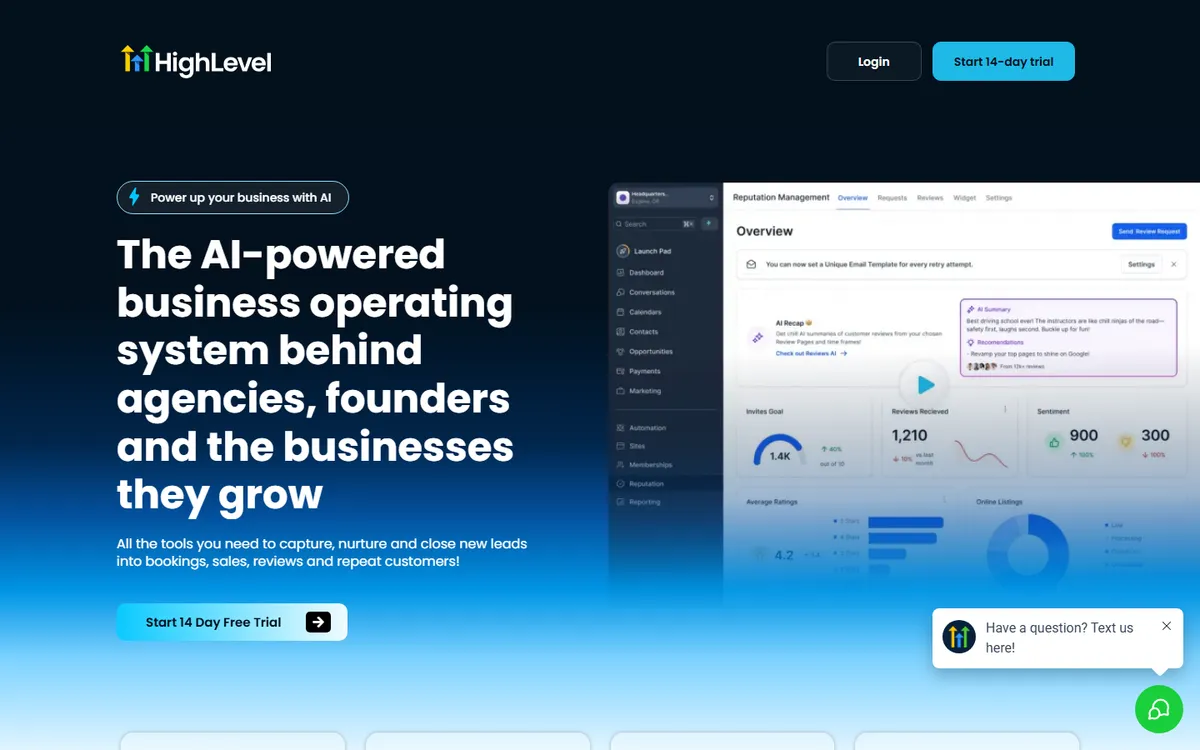 HighLevel’s homepage, November 2026.
Build your offer in your own account first, exactly like a real client would use it. That build becomes your demo, then your snapshot. My GoHighLevel snapshots guide walks through building and testing one properly, and if your offer leans on AI agents specifically, GoHighLevel AI agents covers Voice AI and Conversation AI setup.
Start your 30-day extended free trial 30-day trial · cancel anytime · keep the bonuses I may earn a commission if you sign up through my link, at no extra cost to you. DetailsStep 5: get clients (introductions, not referrals)
This is the part I know best from ten years of selling face to face, and it’s the same path I lay out on my start here page:
- Start with your warm audience. Social connections, past coworkers, friends and family who own businesses. They’ll take your call when a stranger won’t.
- Post one announcement about what you now offer, and ask who they know that needs it.
- Do the first one or two free or at a steep discount, in exchange for honest feedback and a testimonial. Say it plainly, and ask for a review when you deliver.
- Run your whole warm list before you go looking for strangers.
- Then work a local area in person. Walk into businesses in your niche, keep it to two minutes, leave something behind, and come back a week later.
- Ask for introductions, not referrals. “Do you know anybody who needs this?” gets a polite maybe. “Would you introduce me to one or two other [niche] you know, and I’ll give them the same deal?” gets names.
Starting with your warm list
Pros
- They'll take your call when a stranger won't
- Costs nothing to start
- Gives you a testimonial for the next sale
Cons
- The first one or two clients are free or at a steep discount
- You need to run the whole list before looking for strangers
Quick wins
Want clients this month? Start here
Set up your own house first. One clear offer for one niche, a simple site, a booking link and your own HighLevel account running the same automations you'll sell. Prospects trust what they can try.
Start with people who already know you
Past employers, old customers, friends who own businesses. Tell them exactly what you set up for local service businesses and ask for 20 minutes.
Do daily outreach
Calls, emails and DMs to a tight list in one niche. Volume and follow-up beat clever copy.
Demo, don't describe
Build a quick AI agent or missed-call text-back demo in your own HighLevel account and let them try it on the call.
Post what you build
Short screen recordings of real automations. One a day on the platform your buyers use.
Partner with people who own your buyers
Web designers, bookkeepers and software resellers already have the relationship. Trade introductions.
Answer every lead in under a minute
Practice what you sell. Set up your own speed-to-lead automation first.
Work a local area in person
- Pick one area and walk into ten businesses in a row. Ask for the owner, keep it to two minutes and leave a card.
- Bring a one-page printout that shows the problem you fix (missed calls, slow follow-up, no reviews) with their name on it.
- Go back a week later. Most first visits are about being remembered, not closing.
Ask for introductions, not referrals
"Know anyone who could use this?" gets a polite "I'll think about it." Asking to be introduced to a specific kind of person gets names. Set it up when they sign:
"If this works the way I think it will, would you be against introducing me to one or two other local service businesses you know? I'll give them a a free missed-call audit."
Then follow up once they're seeing results. With a client you get along with, a little humor works:
"So are you keeping me a secret on purpose, or do you just not like your friends?"
Only joke like that with clients you know well. With everyone else, keep it simple and thank them either way.
If you’d rather not build the outreach system from scratch, I’ll set up your cold outreach system for you as part of the Growth Plan ($97/month, now with 3 sub-accounts included), on top of HighLevel already configured for local service businesses. See every bonus here, or book a call first if you want to talk through where you’re starting from.
Step 6: deliver, report and retain
The sale is the easy part compared to keeping a client past month three. A few habits that have kept our clients at The Lead Venture:
- Onboard with a real call, not just a login, and show the system working on their own phone number.
- Check in during week one, when most setup problems actually show up.
- Report in plain numbers: calls answered, leads followed up, jobs booked. Skip the dashboard jargon.
- Fold what you learn back into your snapshot, so every client after this one starts further ahead.
Step 7: price and scale
Price in two parts, the same way we do at The Lead Venture: a setup fee for your time building the account and workflows, and a monthly fee for the ongoing platform and support. Decide upfront whether usage (calls, texts, AI) is included, passed through at cost, or billed with a markup, and get that in writing before a client signs.
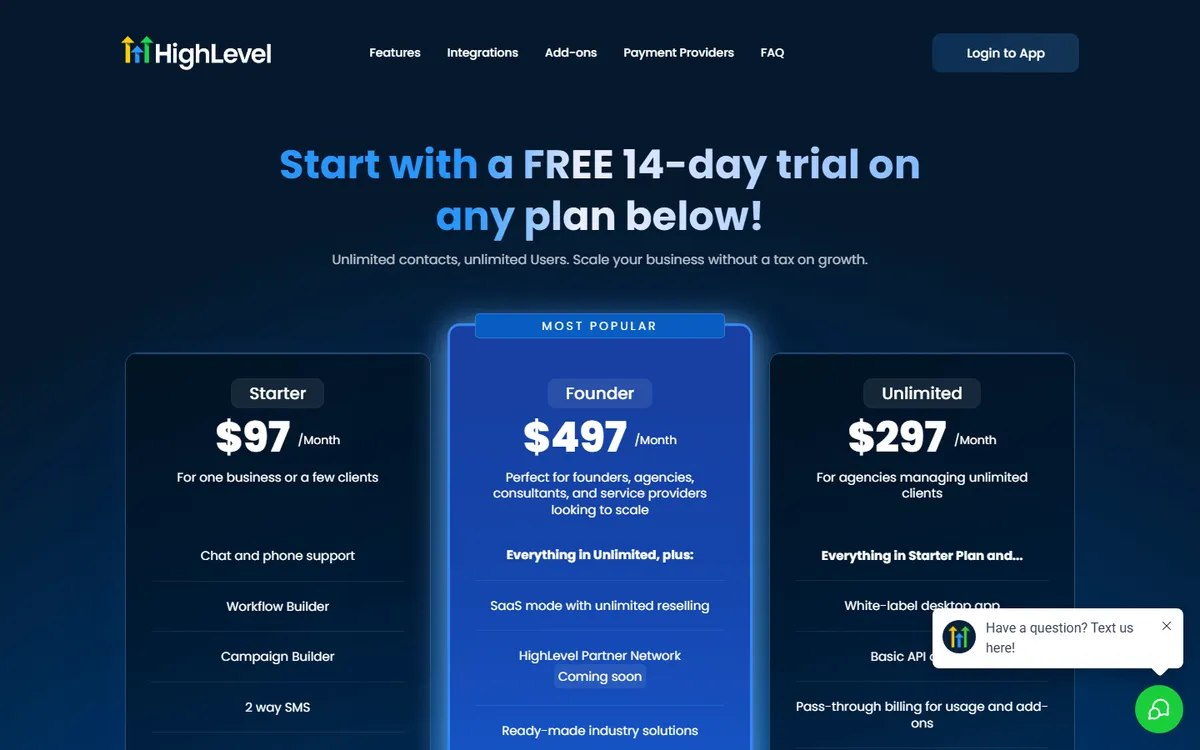 HighLevel’s pricing page, November 2026.
My GoHighLevel pricing breakdown has the real usage numbers, and once your offer is repeatable across clients, SaaS mode on HighLevel’s Founder plan is how you turn it into automatic signup and billing instead of manual invoicing.
SMMA vs AI agency vs niche agency: which to start in 2026
These labels get used loosely. Here’s how I’d think about them:
- SMMA traditionally means social content and ad management. It’s a real business, and it’s also the most crowded label, so differentiation matters more than ever.
- AI agency sells automation directly: AI agents and workflows that answer and follow up on leads. I wrote the full plan for that path in how to start an AI agency.
- Niche agency isn’t really a different category. It’s the positioning layer that should sit under either one. “I run AI follow-up for roofers” beats “I’m an SMMA” or “I’m an AI agency” on their own, because it tells the buyer exactly who you’re for.
SMMA
- Sells: Social content and ad management
- Watch for: Differentiation matters more than ever
AI agency
- Sells: AI agents and workflows that answer and follow up on leads
- Plan: See my how to start an AI agency guide
Niche agency
- Sells: Either one, aimed at one buyer
- Example: "I run AI follow-up for roofers"
My honest take for 2026: pick the niche first, then decide whether your offer leans more toward content, automation or both. The label matters far less than whether you can describe your buyer’s problem better than they can.
Free 30-day launch checklist
Compressed into a month, here’s the order:
- Week 1: Pick your niche. Start the 30-day extended free trial through my link and build your offer in your own account.
- Week 2: Finish your snapshot and set your pricing. Post your announcement and start your warm list.
- Week 3: Close your first one or two clients, free or discounted, for a testimonial. Onboard them properly.
- Week 4: Ask for introductions, start local outreach, and post consistently.
| Week | Focus |
|---|---|
| 1 | Pick your niche, start the free trial, build your offer in your own account |
| 2 | Finish your snapshot, set pricing, post your announcement, start your warm list |
| 3 | Close your first one or two clients for a testimonial and onboard them properly |
| 4 | Ask for introductions, start local outreach, post consistently |
If you’ve already signed up for HighLevel through my link, claim your free onboarding call and email series here. If you want help with the parts that aren’t the software, my coaching waitlist is built around exactly this plan. I built the same system at The Lead Venture, my own agency, as the proof that it works before I ever wrote it down for anyone else.
Bottom line
Starting a marketing agency in 2026 isn’t about finding an untapped niche or a secret tool. It’s picking one you actually understand, building one offer around a real problem, setting up your stack once, and getting your first clients the way people have always gotten first clients: by asking the people who already trust them.
Start your 30-day extended free trial 30-day trial · cancel anytime · keep the bonuses I may earn a commission if you sign up through my link, at no extra cost to you. Details