 Jonathan Blake

If you sell courses or coaching, you have probably been told to pick Kajabi, and then someone in a Facebook group told you HighLevel does it all for less. Both statements have some truth in them. They are built for different jobs.
Short answer: pick Kajabi if you sell self-serve courses and want the smoothest experience for students. Pick GoHighLevel if you sell on calls, need texting and follow-up, or want one system for the whole business. Kajabi is built for the student. HighLevel is built for the sale.
I run my own business on HighLevel and earn a commission if you sign up through my link, so weigh my opinion with that in mind. I have also kept a full section on where Kajabi wins, because for some people it is the right call.
GoHighLevel
- Starts at: $97/month
- Best for: Coaches and sellers who close on calls and texts
- Free trial: 14 days, or 30 days through my link
Kajabi
- Starts at: $179/month (Basic, monthly billing)
- Best for: Self-serve courses and a clean student area
- Free trial: Listed on its pricing page
GoHighLevel vs Kajabi at a glance
| Item | GoHighLevel | Kajabi |
|---|---|---|
| Built for | Selling, follow-up and running client or business systems | Creating and selling courses, coaching and communities |
| Price model | Flat monthly, unlimited users and contacts | Tiered, with contact and product limits |
| Entry price | $97/month | $179/month on monthly billing |
| CRM and pipeline | Built in, with multiple pipelines | Creator-style contact tools |
| Two-way texting | Built in, pay per message | Not found on its pricing page |
| Courses and memberships | Yes, less polished for students | Yes, the core of the product |
| Calendar and call booking | Built in | Check current features |
| White label and reselling | Yes | No |
| AI | Conversation AI, Voice AI, AI Employee plans | Check current features |
Pricing compared (real monthly cost)
HighLevel is $97, $297 or $497 a month as of late 2026. Every plan has unlimited contacts and users. The $97 plan includes three client accounts, and the $297 plan is for unlimited accounts. Pricing details are in my GoHighLevel pricing breakdown. Usage is billed on top: a text is about $0.00747 per segment, a local number is $1.15 a month and outbound calls are about $0.0166 a minute. In my example of 1,000 texts, 400 outbound minutes, 300 inbound minutes and one local number, usage came to $18.76 a month.
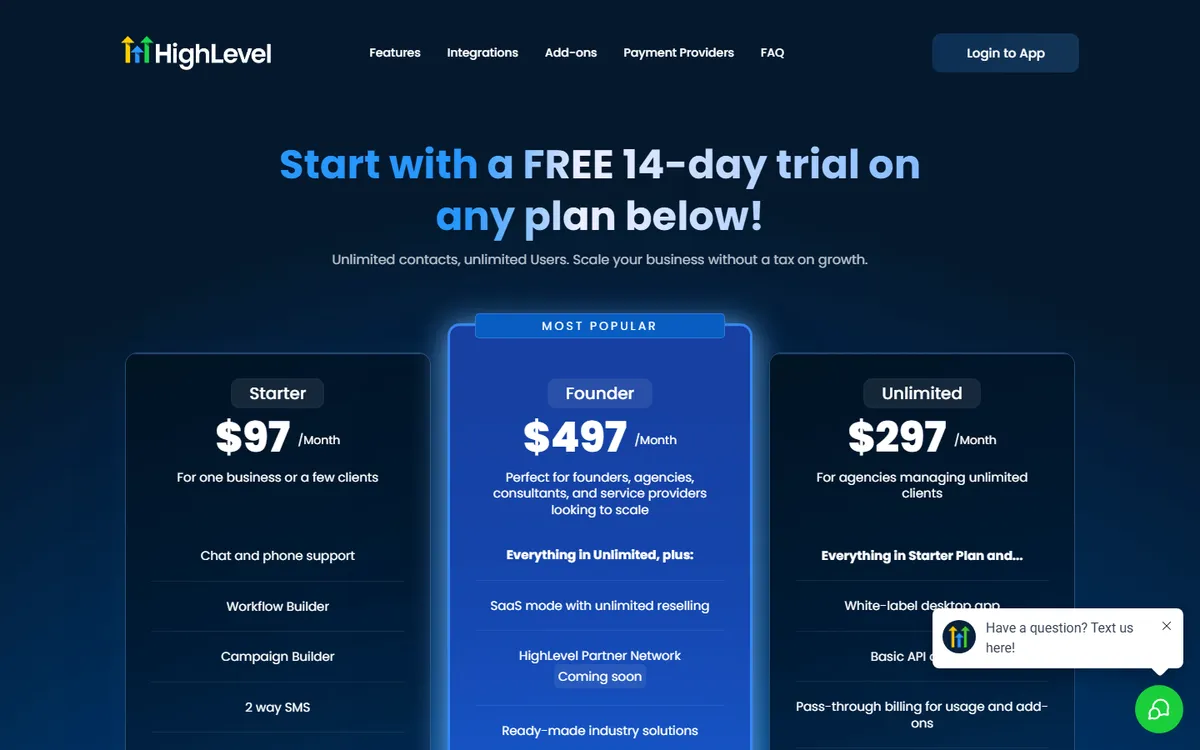 HighLevel’s pricing page, November 2026.
Kajabi’s pricing page lists Basic at $179 a month, Growth at $249 and Pro at $499 on monthly billing, with a discount on annual billing. Basic lists 2,500 contacts and 5 products. Growth lists 25,000 contacts and 50 products. Extra contacts are sold in blocks of 25,000 for $125 a month. Its headline promises 0% revenue share, which is a real point in its favor next to platforms that take a cut of sales.
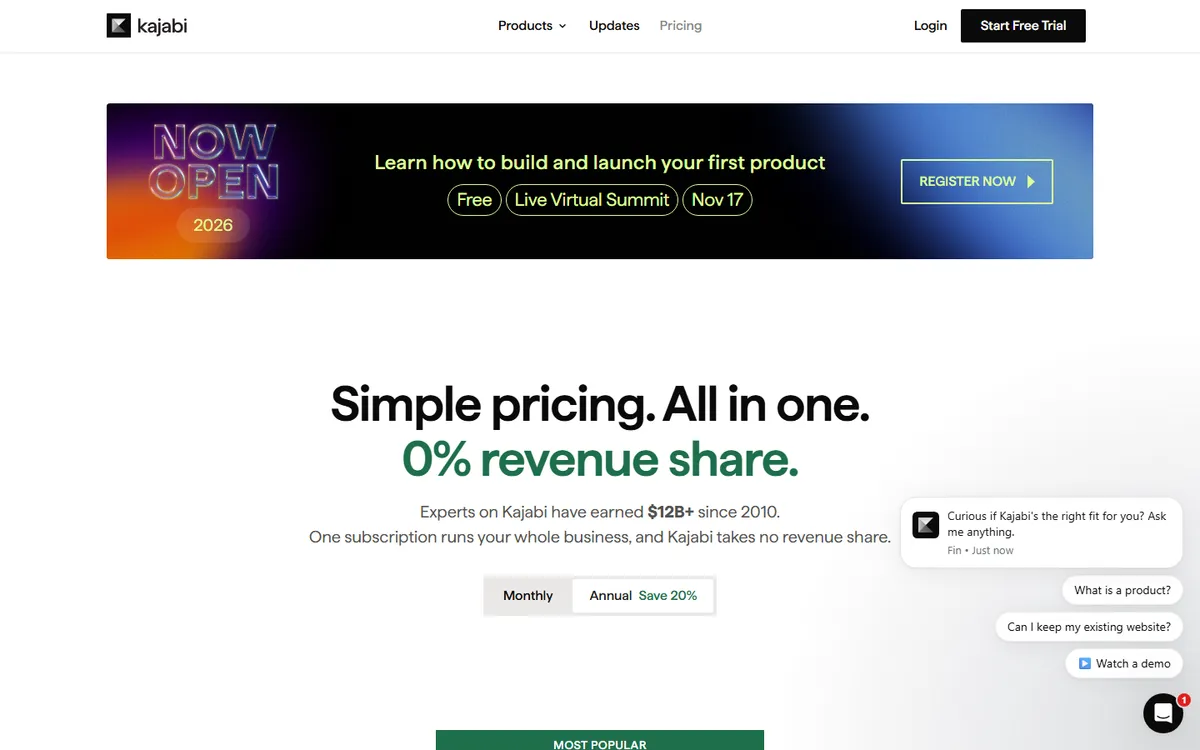 Kajabi’s pricing page, November 2026.
Here is how that plays out for a coach with a growing list:
| Your situation | HighLevel | Kajabi |
|---|---|---|
| Just starting, under 2,500 contacts | $97/month plus usage | $179/month (Basic) |
| 10,000 contacts, a few offers | $97 or $297/month plus usage | $249/month (Growth), check current pricing |
| 30,000 contacts | Same flat plan plus usage | Past the Growth contact limit, so extra blocks apply |
The gap widens as your list grows, because HighLevel does not charge by contact. The catch is that HighLevel’s usage fees climb with how much you text and call, so a very active list costs real money. Settle who pays for usage before you scale a campaign.
Where Kajabi wins
I will say this plainly: if your whole business is selling courses, Kajabi is hard to beat for simplicity.
- The student experience. Kajabi was built around courses, communities and coaching programs. It is clean, consistent and easy for a student to use on day one.
- Less setup. You can have a course live much faster in Kajabi than in HighLevel. The product has fewer places to get lost.
- A single focus. You are not paying for a phone system, a CRM and a funnel builder you will never open.
- No revenue share. Its pricing page makes this a headline feature.
If you are a creator who posts content, sells a self-serve course and rarely talks to a buyer, Kajabi does what you need and gets out of your way.
Where GoHighLevel wins
HighLevel wins when selling is a conversation. It has a full CRM, two-way texting, call booking, forms, funnels, email and a workflow builder in the same place as your memberships. If funnels matter more than courses, I compared GoHighLevel vs ClickFunnels too.
- Follow-up that closes. Texts, emails and tasks fire when someone books, no-shows, goes quiet or buys. I cover the principle in speed to lead.
- Calls and booking. A coaching business that closes on discovery calls needs a calendar, reminders and a pipeline, and HighLevel has all three built in.
- Reusable setups. Snapshots let you copy a working setup to a new offer or client instead of rebuilding it.
- White label and reselling. You can brand the platform and, on the $497 plan, resell it. See GoHighLevel white label.
- Flat pricing as you grow. No contact tiers.
A course platform doesn’t fail because the videos are bad. It fails because nobody followed up with the people who watched the first lesson and stopped.
GoHighLevel for coaches and course sellers
Pros
- Flat pricing with unlimited contacts and users
- Texting, calls, booking and a pipeline built in
- Snapshots, white label and SaaS mode
- One login for courses, funnels and follow-up
Cons
- Student area is less polished than Kajabi's
- Steeper learning curve and longer setup
- Usage fees for texts, calls and email
- Support quality varies
Kajabi
Pros
- Clean, easy student experience
- Fast to launch a course
- 0% revenue share on its pricing page
- Focused product with fewer moving parts
Cons
- Higher entry price and contact limits per plan
- Not built around calls and texting
- No white label to resell
- Extra contacts cost more as you grow
Courses, memberships and the student experience
This is the category where Kajabi earns its price. Its whole product is organized around the person taking the course: lessons, progress, a community and a branded login. A student who has never used the platform can find their way around without help.
HighLevel can host courses and memberships too, and I have used it that way. The difference is polish. It works, but it feels like one feature in a large platform, not the main event. If your students are non-technical and you are selling a premium program where the learning experience is the product, that gap matters. If your students are mostly there for a result and a few calls with you, it matters much less.
Edge: Kajabi for the student. HighLevel for everything around the student.
Automation, texting and follow-up
This is where the two split the other way. HighLevel’s workflow builder runs on every plan. A lead fills out a form, gets a text, books a call, gets reminders, no-shows, gets a nudge, and moves across the pipeline without you touching it. The same account holds the phone number, the calendar and the inbox, so the whole conversation sits in one thread.
Kajabi has contact and email tools aimed at creators. That works well for newsletters, launches and course delivery. I did not find built-in two-way texting or a call-based pipeline on its pricing page, so if you sell through conversations, you would be adding other tools around it. Check what your plan includes before you build a sales process on it.
Edge: HighLevel for anyone who sells through conversations.
Ease of use and learning curve
Kajabi is easier to learn. The menus are predictable, the product does fewer things and a first course can be live quickly.
HighLevel has a steeper curve. It does more in one place, and the settings can feel scattered when you are new. The upside is that once you have built something good, a snapshot lets you copy it, so you rarely build the same thing twice. If you are the one building and running the system, the learning curve is a cost you pay once. If you want to hand a tool to a team member and never think about it, Kajabi is the gentler choice.
Support and ecosystem
Kajabi is a focused product with a clear audience, and its pricing page leans on that. HighLevel’s ecosystem is broader and more agency-flavored: snapshot sellers, a busy community on Facebook and YouTube, and an API for building integrations. Support quality on HighLevel varies. I have had fast answers and slow ones, and the community often replies faster than a ticket does.
Which should you pick?
- If you sell self-serve courses and rarely talk to buyers, pick Kajabi. The simplicity is worth the price.
- If you sell high-ticket coaching on calls, pick HighLevel. The pipeline, texting and booking will pay for themselves faster than a nicer course page.
- If you run a mix, with a cheap course and a premium coaching offer, lean HighLevel, and keep the course where it already lives while you test.
- If you serve other businesses, like consultants who build funnels for clients, pick HighLevel, because only it lets you run and resell many accounts.
- If you are still testing your first offer, neither is urgent. Use the cheapest option that lets you collect leads and take a payment.
Switching from Kajabi to GoHighLevel
If you decide to move, here is the order I would use:
- Export your contacts from Kajabi as a CSV and keep a copy of everything you can download.
- Create matching custom fields and tags in HighLevel before you import, so nothing lands in the wrong place.
- Set up your offers and checkout so payments work before anyone is moved.
- Rebuild the student area by re-uploading videos and files into a HighLevel membership. This is the slow step.
- Rebuild your email sequences and automations, starting with the welcome and the stalled-student follow-up.
- Register your phone number for texting early, because carrier approval takes time.
- Run both for a few weeks and move one offer at a time, not the whole library.
If you want a wider look at your options, see Kajabi alternatives and my full list of software alternatives.
My pick and why
If your business runs on calls, texts and follow-up, I pick HighLevel. It does the selling side of a coaching or course business better than a course platform does, and flat pricing gets friendlier as your list grows. If your business is a self-serve course library and a happy community, Kajabi is the cleaner product and I would not talk you out of it.
Read my full GoHighLevel review if you want to see the rest of the platform. If you want help rebuilding a Kajabi setup, that is a common consulting project.
Try HighLevel side by side
The best test is to rebuild one real offer during the trial. Start through my link and you get a 30-day extended free trial instead of the standard 14 days. Build one landing page, one booking calendar, one pipeline and one text follow-up, and see whether it fits how you sell. If you want guidance on filling that pipeline, look at my coaching.
Start your free HighLevel trial 30-day trial · cancel anytime · keep the bonuses I may earn a commission if you sign up through my link, at no extra cost to you. Details